
On September 14, 2026, I presented a paper by Zoom at HUMAN’26, a workshop associated with the ACM Hypertext conference in London. The paper asks a deceptively simple question: When you are working on a document, why is it still so hard to get back to everything that matters because of its relationship to that document?
Imagine that you are revising a paper. Its Word document is open. Elsewhere are the outline, source PDFs, notes, an email from a reviewer, a figure, the submission instructions, and a task list. You know they are related, but they live in different apps. Finding each one can mean recalling where you put it, switching apps, inventing search terms, and then recovering your train of thought.
Search is useful. Yet the question you need to ask is often not “Where is the file containing these words?” It is “What belongs with the thing I am working on now?” I call the difficulty of answering that question the meta-access problem: the problem of accessing information because of its relationship to the information currently in the foreground.
My paper proposes hyper-relevant contextual information retrieval (HR-CIR) as a way to address it. “Hyper-relevant” means relevant to your immediate work context, not simply similar in subject matter. The central move is to use the current document, email, task, PDF, note, or other resource as a retrieval cue. Open its context, and the system can show both relationships you deliberately saved and potentially useful relationships it inferred. The resources stay in their own apps.
Start with what is in front of you
Most retrieval tools start by asking something of you. A search engine asks for a query. A bookmark manager asks you to browse or search a collection. HR-CIR starts with the foreground resource: the persistent digital item occupying your attention. It treats that item as a clue to the surrounding work.
Suppose you are reading a research paper as a PDF. Its context might offer your notes, the corresponding Bookends or Zotero record, an email discussion, a cited paper, and a task to follow up on a claim. Some of those connections may be explicit links you made. Others could be recommendations drawn from a DOI, citation relationships, metadata, or other evidence. You can follow one and return without losing sight of the paper that prompted the inquiry.
The same principle applies to writing. Returning to a manuscript after several weeks should give you a practical way back into its working context: outline, reference collection, figures, correspondence, and tasks. The manuscript becomes an access point to the project, not merely one file among many.
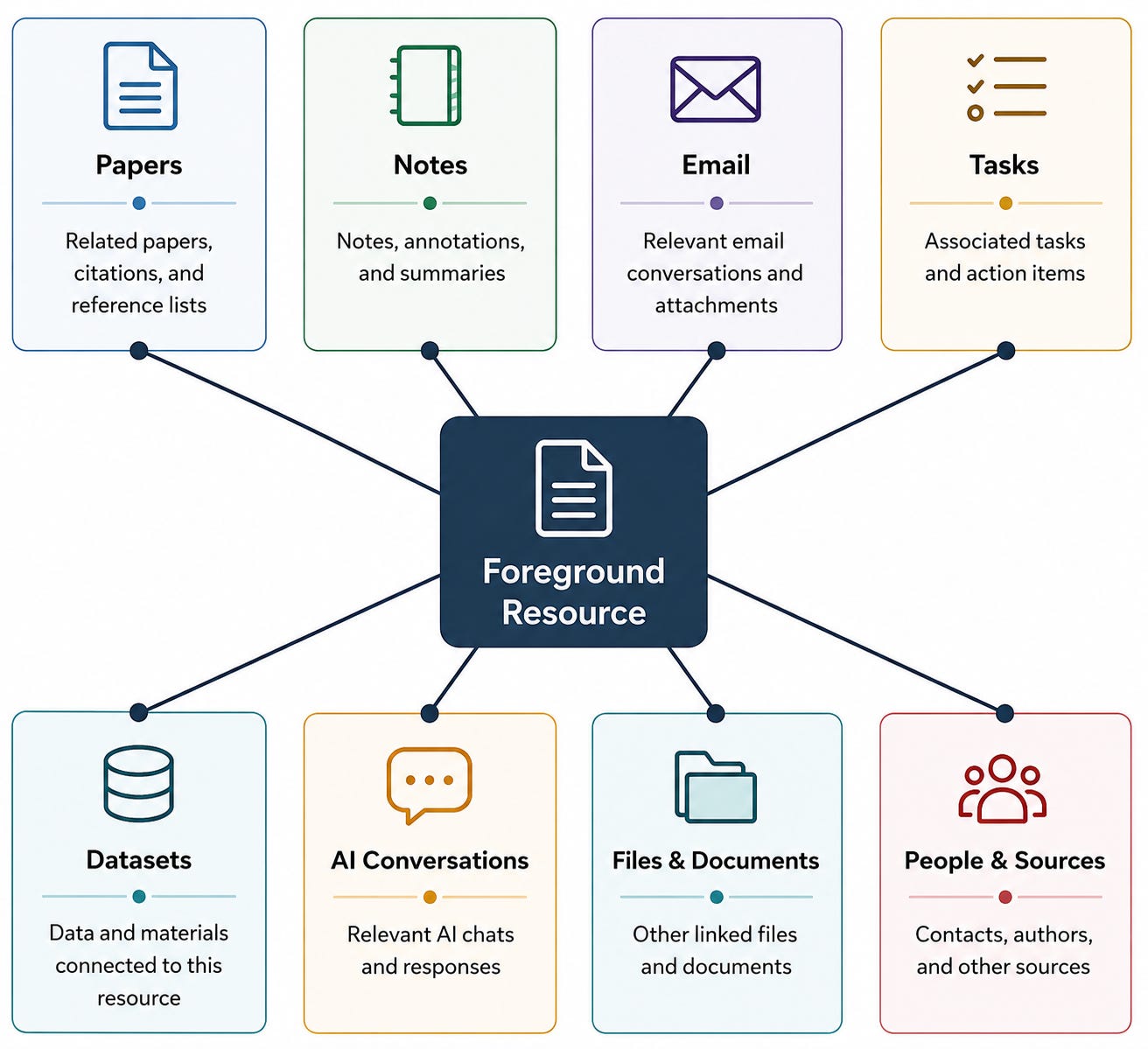
This is a form of hypertext across apps. It does not require you to move all your information into a single repository. A note can remain in your preferred notes app, a task in your task manager, and an email in your mail app. What matters is that each resource has a reliable address and that relationships between resources can be made navigable.
Why call this an extension of working memory
When we work on a complex problem, we cannot keep every relevant argument, source, objection, and unfinished task in mind at once. Psychologists K. Anders Ericsson and Walter Kintsch used the term long-term working memory to describe how experts use learned retrieval structures to access relevant knowledge rapidly while performing a task. My proposal is not that a software link gives someone expertise. It is that a link tied to the current task can play an analogous role as an external retrieval cue: it helps a person bring something useful back into active thought at the moment of need.
This matters for more than speed. An interruption to search for a source also asks you to decide where to look, remember a title or keyword, assess results, and reconstruct what you had been thinking. Making the right relationships accessible can reduce that burden and leave more attention for interpreting, comparing, criticizing, and writing.
In my Cognitive Productivity framework, this supports Strategic Surfing: the deliberate use of searching, browsing, skimming, scanning, and contextual retrieval in the service of deeper work. Light, purposeful retrieval is part of serious thinking. It becomes a problem when the mechanics of retrieval repeatedly displace the thinking they are meant to support.
What does consciousness have to do with it?
The title of my paper also invokes consciousness, and that deserves care. I draw on Merlin Donald’s account of consciousness as involving governance over more than the immediate moment. (See for example his excellent book, A Mind So Rare: The Evolution of Human Consciousness.) We maintain projects and lines of thought across interruptions and long stretches of time. Donald also describes how a computer display can serve as a temporary external working memory field as we look, write, and think.
A display by itself shows only what is open. Contextual retrieval can make the larger network around that item accessible again. When a paper brings its notes and sources into view, those external representations can re-enter the current episode of thought. When the links remain usable months later, they can help us resume a longer-running project. Whereas most theories of consciousness emphasize only sensory and working memory, Donald emphasizes intermediate and long-term governance. He emphasizes that external knowledge resources (external symbolic representations) can become part of a longer term conscious governance. This is possible due to what he calls the theoretic evolutionary transition in human consciousness.
However, I do not mean that software becomes conscious, or that it literally enlarges the brain’s memory capacity. My claim is about the effective reach of a person’s conscious thought and control: what relevant knowledge they can bring to bear, when they can bring it to bear, and how readily they can sustain a project over time. That is also a matter of epistemic agency, our capacity to direct our dealings with knowledge in pursuit of our goals. (See my Substack article on epistemic agency
From deliberate links to useful recommendations
The paper distinguishes two kinds of relationships. An explicit link records a connection you consider worth keeping. For example, you might link a reviewer’s email to your manuscript, or a note to the PDF that prompted it. In addition, contextual information retrieval software should be able to make contextual recommendations that you passively are presented with — i.e., it proposes a resource you did not link yourself: perhaps a cited paper, a page sharing a DOI, or a document identified through another app. Whereas web recommendations (e.g., which Google and Amazon show you) are designed to serve the interests of the company, hyper-relevant contextual recommendations serve your knowledge-building needs.
Both belong in the same view, but they should be distinguishable. A system ought to allow you to understand why it suggested something, let you dismiss irrelevant results, and keep you in charge of which relationships become durable parts of your work. A promising direction is for accepted recommendations to become explicit links when you decide they matter.
I designed Hookmark, the macOS app developed by my company, CogSci Apps, as an example of what this architecture can already do. Its context window shows links associated with the current item and has a RELATED section for recommendations. Hookmark is an illustration and a practical demonstration of feasibility; the paper’s broader proposal is a retrieval approach that could be implemented in other ways and on other platforms. I disclose my connection to the product in the paper.
This is a conceptual and design paper, not a controlled study showing that the approach improves memory or consciousness. Research still needs to test it in real reading and writing: not just how quickly people retrieve items, but how well they resume interrupted work, maintain continuity of thought, avoid distraction, and exercise control over their information environment.
The practical idea is simple: a resource you have already found should help you find your way back to the work around it. If our software gets better at restoring that context, it may help us use what we know more effectively and carry our thoughts further across both apps and time.
Both search and contextual information retrieval have their place. What’s stunning however is that by default, desktop and mobile operating systems do not provide contextual information retrieval. Hookmark and link-friendly software solve this problem
Twenty-four developers, professors and leaders co-signed the Manifesto for Ubiquitous Linking, which I wrote in 2020, advocates for software to be contextually aware, which means they must be link-friendly. The manifesto mimics the structure of the famous Agile Manifesto for software development. If you agree with this article, I invite you to sign and share the manifesto.
Read the full article on ResearchGate.
Colophon
ChatGPT co-authored this Substack article with me.