If Intelligence Isn't Binary, What Is It?
An Architectural Conception of Intelligence

This is a long article. So I’ve included an abstract and a table of contents.
Figure 1: Overview
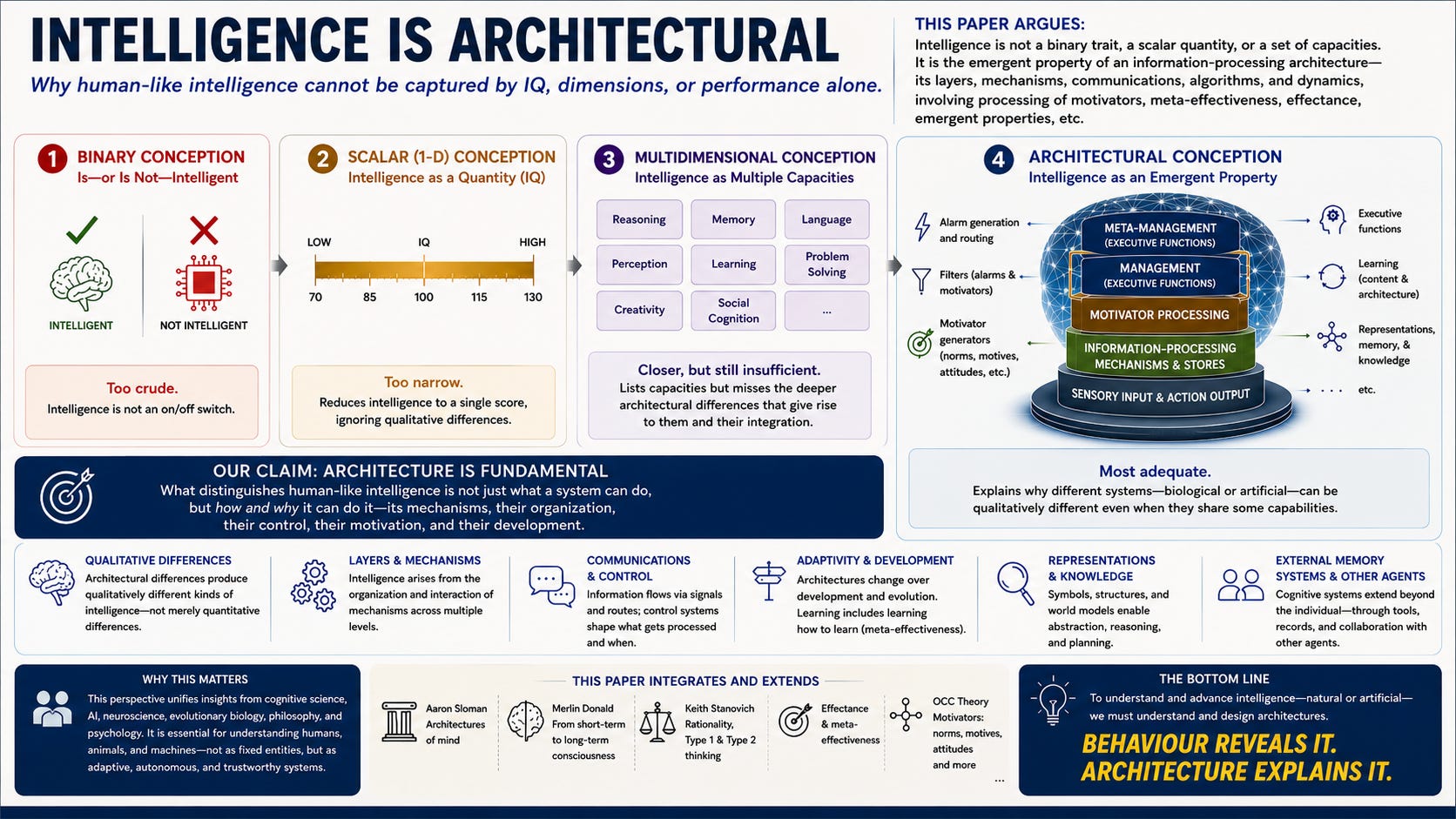
This figure includes a very incomplete architecture diagram. A more complete diagram is included in the article as Figure 2 below.
Abstract
Debates about artificial intelligence often ask whether AI is—or is not—intelligent. Such questions typically assume that intelligence is fundamentally a binary property. This paper argues that binary conceptions, while useful in some contexts, are inadequate for understanding either human or artificial intelligence. After distinguishing binary, scalar, and multidimensional conceptions of intelligence, it proposes an architectural conception in which intelligence is understood more fundamentally as a property of information-processing architectures.
From this perspective, intelligent behaviour arises from the organization and interaction of architectural mechanisms rather than from a single faculty or independent collection of abilities. Relevant architectural properties include reactive and deliberative processing, working memory, executive organization (including management and meta-management), architecture-based motivation, social information processing, learning, explanation, criticism, productive practice, meta-effectiveness, and the integration of external cognitive resources. These mechanisms develop through experience and interact recursively over time. In humans, they are also embedded in relationships, institutions, cumulative culture, and external symbol systems. Their organization and development produce the flexible and adaptive behaviour commonly associated with intelligence.
The architectural conception explain why humans, other animals, and contemporary AI exhibit both important continuities and significant differences. Rather than asking whether a system is intelligent or assigning it a single intelligence score, the more informative question becomes what kinds of information-processing architecture it possesses, how those architectures develop, and how they support different forms of intelligent behaviour.
This perspective does not replace binary classifications, psychometric measures, or multidimensional models. Instead, it situates them within a broader explanatory framework. Performance remains indispensable, but it is interpreted as evidence from which architectural properties are inferred rather than as intelligence itself. Recasting intelligence in architectural terms provides a richer foundation for comparative cognition, psychology, education, psychometrics, and artificial intelligence, while shifting attention from measuring intelligent performance to understanding the architectures that make such performance possible.
The paper concludes that intelligence is best understood not as a binary property, a single quantity, or merely a multidimensional profile, but more fundamentally as a property of information-processing architectures.
Contents
Introduction: If Intelligence Isn’t Binary, What Is It?
…. 1.1 From rejecting a bad question to developing a better answer
…. 1.2 Three familiar ways of thinking about intelligence
…. 1.3 Description is not yet explanation
…. 1.4 The missing level of explanation: information-processing architectures of intelligence
…. 1.5 Aaron Sloman and the space of possible minds
…. 1.6 From the space of possible minds to human-like intelligence
…. 1.7 An Integrative Design-Oriented ApproachFour Ways of Thinking About Intelligence
…. 2.1 The binary conception
…. 2.2 The scalar conception
…. 2.3 The multidimensional conception
…. 2.4 The architectural conception
…. 2.5 Comparing the four conceptionsThe Information-Processing Architectural Tradition
…. 3.1 What is an information-processing architecture?
…. 3.2 Human-like Autonomous Agency Architecture (HAAA)
…. 3.3 Allen Newell and the pursuit of unified theories of cognition
…. 3.4 Aaron Sloman and the broader information-processing perspective
…. 3.5 From the Space of Possible Minds to Human-Like Intelligence
…. 3.6 Why Intelligence Research Needs Better Theory
…. 3.7 An Integrative Design-Oriented Approach to Autonomous AgencyArchitectural Innovations Underlying Human-Like Autonomous Agency Through Evolution
Architectural Mechanisms Underlying Human-Like Autonomous Agency
…. 5.1 Reactive processing, management, and meta-management
…. 5.2 Motivator generation, evaluation, and control
…. 5.3 Alarm mechanisms, attention, interruption, and perturbance
…. 5.4 Memory, self-reminding, and governance across time
…. 5.5 Learning, explanation, and architectural development
…. 5.6 External cognitive scaffolding
…. 5.7 Social Information-Processing Mechanisms
…. 5.8 From evolutionary innovations to architectural mechanismsLearning, Architectural Change, and Meta-Effectiveness
…. 6.1 Learning as architectural change
…. 6.2 Sample Efficiency and Architectural Learning
…. 6.3 Productive Practice and Architectural Development
…. 6.4 Explanation, Criticism, and Error Correction
…. …. 6.4.1 Explanation
…. …. 6.4.2 Criticism
…. …. 6.4.3 Error Correction
…. …. 6.4.4 Self-Explanation
…. …. 6.4.5 A Recursive Cycle of Architectural Development
…. 6.5 Meta-effectiveness
…. 6.6 Humans, Other Animals, and Contemporary Al
…. …. 6.6.1 An Architectural Comparison
6.7 Implications for the concept of intelligenceIntelligence Reconsidered
…. 7.1 Intelligence as an Architectural Property
…. 7.2 Implications for Research and Assessment
…. 7.3 Developing Intelligence
…. 7.4 Final Reflections
Colophon
Future
1. Introduction: If Intelligence Isn’t Binary, What Is It?
1.1 From rejecting a bad question to developing a better answer
Debates about artificial intelligence often revolve around a deceptively simple question:
Is AI intelligent?
Some people answer yes, pointing to the ability of contemporary AI systems to write, reason, translate, program, explain difficult ideas, pass examinations, and solve problems that once seemed to require human intelligence. Others answer no, arguing that these systems merely manipulate patterns, predict tokens, or simulate capacities they do not genuinely possess.
But not everyone treats intelligence as an all-or-none property. Many commentators instead describe AI as more or less intelligent than humans, or as highly intelligent in some respects but profoundly limited in others. Some compare systems using benchmarks or IQ-like scores. Others emphasize distinct capacities such as linguistic competence, planning, learning, creativity, social understanding, or embodied action.
The debate therefore reflects several different conceptions of intelligence, often left implicit. People may appear to disagree about whether AI is intelligent when they are actually using different ideas of what intelligence is.
In my earlier essay, Why You Can’t Say AI Is—or Is Not—Intelligent, I argued principally against the binary formulation. Saying simply that an AI system either is or is not intelligent obscures the complexity of both natural and artificial minds. Yet rejecting that formulation does not by itself give us an adequate positive account of intelligence.
If intelligence is not binary, what is it? That is the question addressed in the present essay.
1.2 Three familiar ways of thinking about intelligence
At least three familiar conceptions already shape discussions of intelligence.
The binary conception treats intelligence as something a creature or system either possesses or lacks.
The scalar conception treats it as a quantity, allowing one person or system to be ranked above another.
The multidimensional conception instead represents minds as profiles of capacities, such as language, memory, planning, creativity, social understanding, learning, and metacognition.
Each conception can be useful for particular purposes. The difficulty arises when any of them is mistaken for a sufficiently deep explanation of intelligence. Section 2 examines them more carefully before introducing a fourth, architectural conception.
1.3 Description is not yet explanation
A score describes performance. A collection of dimensions provides a richer description of performance. Neither necessarily explains how that performance is produced.
Suppose two systems perform equally well on a planning task. One may construct explicit representations of alternative futures, evaluate them against several competing concerns, schedule intermediate actions, detect conflicts, and revise its plan when circumstances change. Another may have learned statistical regularities that allow it to generate an equally successful answer without using those mechanisms.
At the level of observable performance, the systems may look similar. At the level of their underlying organization, they may be radically different.
Conversely, two systems may display different behaviour despite possessing many of the same mechanisms. Their differences may arise from how attention is allocated, which memories are retrieved, whether an alarm interrupts ongoing activity, which concerns are currently insistent, or whether management and meta-management processes are engaged at that moment.
Behaviour is evidence about intelligence, but it is not the whole explanation of intelligence. To explain intelligent performance, we need to investigate what underlies it.
1.4 The missing level of explanation: information-processing architectures of intelligence
The central proposal of this essay is that intelligence should be understood in relation to information-processing architectures. An information-processing architecture is not simply a list of abilities. It is an organized system of interacting mechanisms, layers, representations, communication pathways, control processes, and forms of learning. It helps determine what information a system can acquire, what it notices, what it remembers, what it values, what alternatives it considers, and how it controls thought and action over time.
This architectural view asks questions that binary, scalar, and multidimensional approaches tend to leave unanswered:
Can the system deliberate about alternatives,
construct and schedule plans,
monitor and redirect its own processing,
respond to alarms,
create and manipulate symbols,
build narratives,
retrieve relevant knowledge, and
govern activity across extended periods?
How are its mechanisms connected, and
which of them are recruited in particular circumstances?
These are not merely additional dimensions to be placed beside memory, language, or creativity. Many concern qualitative differences in organization. An architecture that can schedule deliberation is not simply located farther along a “scheduling dimension” than one that lacks any scheduling mechanism. An architecture with meta-management is not merely more reflective than one without it. The presence of a new mechanism, control layer, or communication pathway may make entirely new forms of intelligent activity possible. Such differences create genuine discontinuities in the space of possible minds—a theme I explore further in Discontinuities: Love, Art, Mind.
This is why the architectural view constitutes a fourth conception of intelligence rather than merely a more elaborate version of the multidimensional view.
1.5 Aaron Sloman and the space of possible minds
This way of thinking has an important history. Aaron Sloman argued from 1984 (if not earlier) onwards that artificial intelligence and cognitive science should investigate the space of possible minds: the vast range of information-processing architectures that could exist in animals, humans, machines, and systems unlike anything yet encountered. His 1978 book The Computer Revolution in Philosophy, his 1981 paper with Monica Croucher, Why Robots Will Have Emotions, and later work such as How Many Beasties Live Within Us? placed global architecture, interacting mechanisms, and qualitative differences among possible minds at the centre of inquiry.
This essay belongs explicitly to that research tradition. I completed my Ph.D. under Aaron Sloman’s supervision at the University of Birmingham. Several architectural ideas discussed here, including the distinction between management and meta-management, were developed in my dissertation and subsequently incorporated into the broader H-CogAff framework.
The contribution of this article is not to claim that the architectural conception originated here, but to distinguish it clearly from binary, scalar, and multidimensional conceptions and to develop its implications for contemporary discussions of human, animal, and artificial intelligence. Section 3 returns to this history in greater detail.
1.6 From the space of possible minds to human-like intelligence
The space of possible minds is vast, and no single essay could adequately map it. My more focused aim is to ask what an information-processing account of human-like intelligence requires.
That question cannot be answered by compiling a checklist of human abilities. Human-like intelligence depends on the dynamic organization of many mechanisms: perception, attention, memory, learning, planning, scheduling, deliberation, evaluation, narrative, executive control, self-reminding, alarm processing, management, and meta-management, among others.
These mechanisms are not all active to the same extent at every moment. The same person may recruit different combinations of them while reading a paper, navigating an emergency, telling a story, making a difficult decision, or reconsidering a long-standing belief. An architectural theory must therefore explain not only differences between humans, animals, and AI systems, but also moment-to-moment differences within the same person.
Intelligence concerns what an information-processing architecture is capable of doing. Rationality concerns whether those capacities are deployed appropriately in pursuit of well-regulated action and belief. As Keith Stanovich has argued, intelligence and rationality should not be conflated. Highly intelligent people may nevertheless reason irrationally, while rationality depends upon additional dispositions, executive processes, and evaluative mechanisms. From an architectural perspective, this distinction reflects differences not merely in cognitive capacity but in the organization of management, meta-management, motivational regulation, and effectance.
This richer account thus eventually carries us beyond intelligence narrowly conceived. Intelligence concerns what an architecture is capable of doing. Rationality also concerns whether, when, and why those capacities are appropriately engaged. A highly capable system may reason badly if it lacks the dispositions, values, executive control, or motivational organization required to use its capacities well.
The discussion will therefore move gradually from intelligence to rationality and autonomous agency. Following Stanovich, intelligence and rationality are treated as related but distinct explanatory concepts: intelligence concerns what an information-processing architecture is capable of doing, whereas rationality concerns how that architecture governs, evaluates, and deploys those capabilities.
The remainder of this essay develops a new way of thinking about intelligence. We begin with the familiar conceptions—binary, scalar, and multidimensional—and then gradually build toward an information-processing architectural account capable of explaining not only human intelligence, but also rationality, autonomous agency, and important similarities and differences between humans and artificial intelligence.
1.7 An Integrative Design-Oriented Approach
The perspective developed here is integrative and design-oriented. It seeks to understand human-like intelligence by analysing autonomous agents as information-processing architectures. It draws upon cognitive science but extends beyond it by integrating motivation, emotion and other forms of affect, executive control, autonomous agency, and the design principles governing complete information-processing systems. This perspective is equally applicable to biological organisms, artificial systems, and hybrids of the two.
Throughout this essay, explanatory priority is given not to isolated cognitive functions but to the organization of complete autonomous information-processing systems.
2. Four Ways of Thinking About Intelligence
The question What is intelligence? has received many answers in psychology, philosophy, education, artificial intelligence, and cognitive science. Some of these answers appear to contradict one another, but the disagreements partly arise because researchers and practitioners are asking different kinds of questions. A practical decision may require a binary classification; a psychologist may want a quantitative score; an educator may be interested in a profile of several abilities; and a cognitive scientist may want to understand what produces those abilities.
In this essay, I distinguish four broad conceptions of intelligence: binary, scalar, multidimensional, and architectural. They are not mutually exclusive, nor do they form a simple historical sequence in which each new conception renders its predecessors useless. Each supports different questions and forms of inquiry. The fourth conception will eventually incorporate the descriptive resources of the preceding three while adding a deeper level of explanation.
2.1 The binary conception
The simplest conception treats intelligence as a binary property. A creature or system either is intelligent or it is not. This way of thinking remains common in everyday conversation and in public debates about artificial intelligence. People ask whether crows are intelligent, whether octopuses are intelligent, whether a large language model is intelligent, or whether some future machine will cross a threshold into “genuine” intelligence.
Binary classifications are sometimes necessary and useful. A clinician may need to determine whether a patient has sufficient cognitive capacity to give informed consent. A licensing authority may need to decide whether someone is cognitively capable of driving safely. An engineer may specify whether a robot can navigate independently in a particular environment. In such contexts, a yes-or-no judgment can support an important practical decision.
The limitation is that binary classifications suppress differences among systems assigned to the same category. Calling both a crow and a human intelligent tells us little about their very different capacities. Similarly, saying that a calculator is not intelligent tells us little about the remarkable narrow competence it possesses in symbolic arithmetic. A binary judgment can tell us whether a system meets a chosen threshold, but it provides only a very coarse characterization of intelligence.
2.2 The scalar conception
The scalar conception replaces the yes-or-no question with a quantitative one:
How intelligent is this person or system?
Psychometric intelligence research transformed the study of human ability by making this question empirically tractable. Rather than relying on general impressions that someone seemed clever, psychologists developed standardized tasks, comparison groups, statistical models, and summary scores. Charles Spearman’s influential 1904 paper, “General Intelligence,” Objectively Determined and Measured, helped establish the idea that performance across diverse cognitive tasks is positively correlated and can be represented partly through a general factor, commonly called g.
A contemporary intelligence test is considerably more sophisticated than the popular image of a few puzzles producing one mysterious number. Consider the Wechsler Adult Intelligence Scale—Fifth Edition, or WAIS–5. Its primary battery uses ten subtests to assess five broad domains: verbal comprehension, visual-spatial ability, fluid reasoning, working memory, and processing speed. Results can be reported as separate index scores, while selected subtests are also combined into a Full Scale IQ.
This example reveals an important subtlety. Modern IQ tests are not one-dimensional instruments in the sense of measuring only one kind of performance. They assess several abilities and provide profiles that can reveal relative strengths and weaknesses. The scalar conception arises because this diverse evidence can also be statistically summarized in one or a few overall scores. Multidimensional measurement and scalar representation can therefore coexist within the same test.
There are good reasons for constructing summary scores. They make comparison possible, can be interpreted against population norms, and often predict outcomes that matter. IQ is neither a meaningless number nor merely an obsolete attempt to rank people. Intelligence testing is one of psychology’s most extensively developed measurement traditions.
Still, a summary score necessarily compresses information. Two people with similar Full Scale IQ scores can have substantially different ability profiles. One may perform especially well on verbal and knowledge-based tasks but less well on processing-speed tasks; another may display the reverse pattern. Even similar index profiles can conceal differences in strategies, dispositions, prior experiences, and learned knowledge. A scalar score provides a useful summary of performance under specified conditions, but it does not preserve every important distinction among the capacities contributing to that performance.
The limitations become even more apparent when scalar measures are extended beyond the human populations for which they were designed. Assigning an “IQ” to a crow, an octopus, or a large language model can be rhetorically striking, but the resulting number may conceal profound differences among the kinds of capacities they possess and the environments in which those capacities operate. A single scale may permit comparison on a defined battery without establishing that the systems being compared possess intelligence of the same kind.
David Perkins’s Outsmarting IQ: The Emerging Science of Learnable Intelligence provides an important bridge beyond a narrowly scalar interpretation. Perkins distinguishes among neural, experiential, and reflective intelligence. Neural intelligence comprises relatively basic processing resources; experiential intelligence consists of the knowledge and expertise acquired through experience; and reflective intelligence concerns the dispositions and strategies through which people monitor, direct, and improve their thinking. Perkins therefore retains the importance of cognitive capacity while showing that intelligent performance also depends on acquired knowledge and on how people use the capacities they possess.
Later in this essay, I reinterpret much of what Perkins calls reflective intelligence in terms of management and meta-management. Reflection can suggest conscious introspection, whereas management includes a broader family of processes: deciding whether to deliberate, allocating attention, selecting strategies, scheduling activities, monitoring progress, interrupting unproductive thinking, and redirecting thought and action. I distinguish management from meta-management in detail in Chapters 4 and 5 of my Ph.D. thesis, Goal Processing in Autonomous Agents.
Perkins helps us see why intelligence is more than a single score. The multidimensional conception develops that insight further by preserving distinctions among several kinds of ability rather than combining them into one overall measure.
2.3 The multidimensional conception
The multidimensional conception begins from the recognition that intelligence cannot always be represented adequately by a single summary score. Instead of asking only how intelligent someone is, it asks:
In what respects is this person or system intelligent?
Modern psychometrics already partly embraces this conception. The Cattell–Horn–Carroll framework, commonly called CHC theory, organizes cognitive abilities hierarchically. Numerous narrow abilities are grouped within broader abilities, while many versions of the model also include a higher-order general factor. CHC theory therefore demonstrates that contemporary psychometrics is considerably richer than the popular idea that psychologists believe intelligence consists of only one undifferentiated quantity.
One important precursor was Raymond Cattell’s distinction between fluid and crystallized intelligence. Fluid intelligence is the capacity to reason about novel problems, detect patterns, and solve unfamiliar tasks without depending heavily on previously acquired knowledge. Crystallized intelligence consists of accumulated knowledge, vocabulary, concepts, procedures, and skills acquired through education and experience. Intelligent performance commonly draws on both: fluid intelligence helps a person respond to novelty, while crystallized intelligence allows the person to exploit what has already been learned.
John Carroll subsequently conducted an extraordinarily extensive synthesis of factor-analytic research on human abilities. His Human Cognitive Abilities: A Survey of Factor-Analytic Studies examined research on language, reasoning, memory, learning, perception, idea production, cognitive speed, knowledge, and other abilities, culminating in a hierarchical three-stratum theory. CHC theory developed from the integration of this work with the Cattell–Horn tradition.
Multidimensional conceptions have developed along at least two rather different lines. One is psychometric. Frameworks such as CHC represent intelligence through multiple measurable cognitive abilities organized hierarchically. Although these abilities can be summarized by higher-order factors such as g, the emphasis is on preserving distinctions among different cognitive capacities.
The second line is more conceptual than psychometric. Howard Gardner’s Frames of Mind: The Theory of Multiple Intelligenceschallenged the idea that intelligence should be identified principally with the academic abilities measured by conventional intelligence tests, proposing instead a number of relatively distinct forms of intelligence. Robert Sternberg’s Beyond IQ: A Triarchic Theory of Human Intelligence argued that intelligence should be understood in terms of analytical, creative, and practical functioning, emphasizing how people adapt to, shape, and select their environments. Researchers have also proposed emotional, social, creative, and successful intelligence. These theories differ substantially in both their theoretical commitments and their empirical support, but they share a dissatisfaction with representing intelligence solely by a single general score.
The multidimensional view is especially attractive when comparing very different kinds of systems. A crow may excel at certain forms of causal reasoning, tool use, and spatial memory while lacking human language. An octopus may display extraordinary sensorimotor adaptability through an organization of control radically different from that of vertebrates. A large language model may generate fluent explanations, translate between languages, write software, and interpret narratives while lacking many forms of bodily control, autonomous motivation, continuous perception, or long-term self-directed learning. Saying that one of these systems is simply more intelligent than another suppresses the distinctive profile of capacities each displays.
Multidimensional approaches commonly represent intelligence as a set—or vector—of quantitative variables. Rather than assigning a system one number, they assign it several numbers corresponding to abilities such as language, memory, planning, spatial reasoning, creativity, emotional understanding, metacognition, or sample efficiency. This is a substantial advance over a single scalar measure because it preserves differences among capacities that an overall score compresses.
Nevertheless, the underlying representation remains numerical. A multidimensional profile tells us how much of each measured capacity a system displays. It may tell us that two systems perform similarly in planning but differently in language, or that one person has relatively stronger verbal than spatial abilities. What it does not necessarily tell us is whether apparently similar capacities arise in the same way. Two systems can receive similar planning scores while relying on very different processes, strategies, or internal organizations.
The multidimensional conception therefore offers a richer description of intelligence than a single score. Its remaining limitation is not that it uses several dimensions, but that it generally continues to represent intelligence as a collection of measured quantities. To understand why systems possess the profiles they do, we need to ask a different kind of question.
2.4 The architectural conception
The architectural conception changes the principal question. Rather than asking only whether a system is intelligent, how intelligent it is, or along which numerical dimensions it excels, it asks:
What information-processing architecture gives rise to its intelligent behaviour?
The notion of an architecture is familiar throughout engineering and computer science. A software architecture specifies the principal components of a system, the responsibilities of those components, and the pathways through which they communicate. It explains how a system is organized rather than merely what it produces. As Len Bass, Paul Clements, and Rick Kazman explain in Software Architecture in Practice, architectural design fundamentally shapes a system’s capabilities, robustness, maintainability, and evolution. The same general idea applies to intelligent systems.
Throughout this essay, an information-processing architecture refers to the organized arrangement of mechanisms, representations, communication pathways, memory systems, evaluative processes, and layers of control that together determine how a system acquires information, evaluates situations, learns, reasons, plans, and acts over time. The architecture is not simply a list of abilities. It is an explanatory model of how those abilities are produced.
Architectures may differ in whether they contain attention filters, planning and scheduling mechanisms, management and meta-management processes, alarm systems, episodic memory, narrative mechanisms, symbolic representations, autonomous motivators, or mechanisms for reasoning under ambiguity. They may also differ in how similar components are connected, what signals can reach which layers, how information flows among them, and which mechanisms are recruited in particular circumstances.
Some architectural differences support quantitative comparisons. Two systems possessing working-memory mechanisms may differ in capacity, precision, duration, or reliability. Two systems capable of planning may differ in how many alternatives they can represent or how far ahead they can search. An architecture can therefore still be characterized as more or less capable in particular respects, and multidimensional numerical profiles remain legitimate descriptions of what it can do.
Other architectural differences are qualitative. An architecture that can schedule deliberation possesses a mechanism unavailable to one that can deliberate only when prompted externally. An architecture with meta-management can evaluate and redirect some of its own management processes; an architecture without meta-management does not merely possess a smaller amount of the same capability. An architecture in which alarm signals can reach both management and meta-management has possibilities for interruption, reassessment, and control unavailable when alarms are confined to lower-level processing. Such differences create genuine discontinuities in the space of possible minds because they introduce new forms of organization and new possibilities for agency.
2.5 Comparing the four conceptions
Substack has trouble formatting tables, so the following table is rendered as an image.
Table 1. Comparing the four conceptions
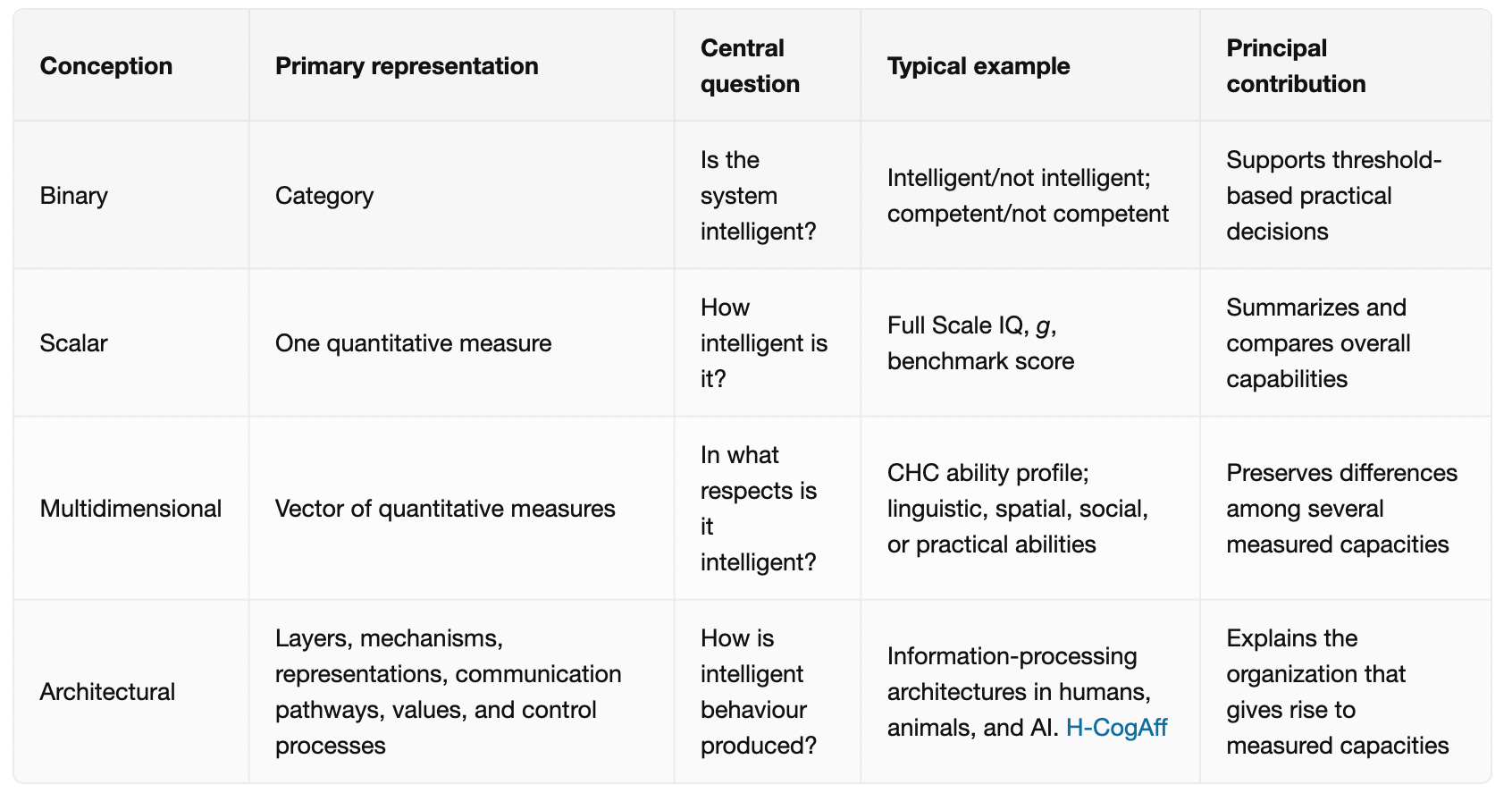
The four conceptions should not be regarded as mutually exclusive boxes or as competing theories from which only one can be correct. They answer different kinds of questions. Binary classifications remain useful for practical decisions. Scalar measures summarize performance. Multidimensional profiles preserve distinctions among different abilities that an overall score compresses. An information-processing architectural account can still support all three: an architecture may satisfy a threshold, perform at a particular level, and display a distinctive multidimensional profile.
The architectural conception therefore extends rather than rejects the preceding views. Its distinctive contribution is to ask what underlying organization gives rise to the classifications, scores, and profiles they provide. Binary classifications tell us whether a system meets a chosen criterion. Scalar measures tell us how it performs overall. Multidimensional profiles tell us where its relative strengths and weaknesses lie. An information-processing architecture helps explain why.
The next sections develop this fourth conception, beginning with Aaron Sloman’s pioneering investigation of information-processing architectures and the space of possible minds.
3. The Information-Processing Architectural Tradition
The preceding section distinguished the architectural conception from binary, scalar, and multidimensional approaches. The next task is to clarify the intellectual tradition behind it and the stronger explanatory demands that architectural models impose.
An architectural comparison must accommodate both quantitative variation and qualitative discontinuities. Humans, other animals, and artificial systems may differ in memory capacity, planning depth, learning speed, or reliability, but also in the mechanisms they possess, the layers into which those mechanisms are organized, the representations they use, and the pathways through which information travels. It must also be dynamic: the same architecture recruits different combinations of attention, memory, evaluation, reasoning, control, and action from moment to moment.
The architectural perspective has a substantial history in artificial intelligence and cognitive science, although it has received far less public attention than IQ, benchmark scores, or theories that divide intelligence into several abilities. Understanding that history helps clarify what an architecture is, what it can explain, and how the present essay extends an established research programme.
3.1 What is an information-processing architecture?
The notion of an architecture is familiar throughout engineering and computer science. A software architecture specifies the principal components of a system, the responsibilities assigned to those components, and the pathways through which they exchange information and exercise control. As Len Bass, Paul Clements, and Rick Kazman explain in Software Architecture in Practice, architectural decisions shape a software system’s behaviour, quality attributes, maintainability, and evolution.
The same general idea applies to understanding intelligent systems. An information-processing architecture specifies the organized arrangement of mechanisms, representations, memory systems, evaluative processes, communication pathways, and layers of control through which a system learns, reasons, plans, acts, and regulates its own activity. Its purpose is not merely to list capacities, but to explain how those capacities are produced and coordinated within one agent.
Architectures can differ in at least four broad ways.
They may contain different layers of processing, including reactive, deliberative, managerial, and meta-managerial processes.
They may differ in the mechanisms contained within those layers—for example, attention control, conflict resolution, self-reminding, strategy selection, scheduling, or ambiguity detection.
They may differ in communication pathways: an alarm may influence only immediate action, may interrupt management, or may also reach meta-management.
Systems may use different representations and algorithms even when they perform similar functions—for example, symbolic structures, vector representations, production rules, neural networks, episodic simulations, or narrative representations.
Some of these differences are quantitative. Two systems with working memory may differ in capacity, duration, precision, or reliability. Others are qualitative. An architecture without a scheduling mechanism cannot merely be described as possessing less scheduling, and one without meta-management does not simply possess less of the same reflective capacity. The presence, absence, and organization of mechanisms create discontinuities in the space of possible minds.
Architectures are also dynamically configured. In an emergency, an alarm may interrupt ongoing thought, redirect attention, increase the priority of urgent concerns, initiate rapid action, and later trigger reflection. While writing an essay, the same person may recruit semantic and episodic memory, narrative construction, analogy, planning, ambiguity detection, self-reminding, and extended deliberation. During rumination, persistent motivators, narrowed attention, repeated retrieval, and failures of disengagement may dominate. The architecture remains broadly stable, but its active configuration changes.
The eventual aim of this essay is to assemble a provisional account of the architecture required for human-like intelligence. That account includes perception and action, multiple forms of memory, learning, planning, scheduling, deliberation, executive functions, alarm mechanisms, management and meta-management, narrative, symbol creation, self-reminding, and evaluative processes responsive not only to goals but also to norms and preferences. Not every important property corresponds to a dedicated mechanism; intelligence, rationality, consciousness, and mental perturbance may emerge from the interaction of many mechanisms.
The architectural perspective developed here belongs to a long tradition within artificial intelligence and cognitive science. Aaron Sloman’s work on information-processing architectures, autonomous agency, and the space of possible minds provides its most direct intellectual foundation, while Allen Newell’s work helped establish architectural explanation as a central approach within cognitive science.
3.2 Human-like Autonomous Agency Architecture (HAAA)
Figure 2 below presents a conceptual architecture for human-like autonomous agency. It summarizes the principal architectural components and their interactions discussed throughout this paper.
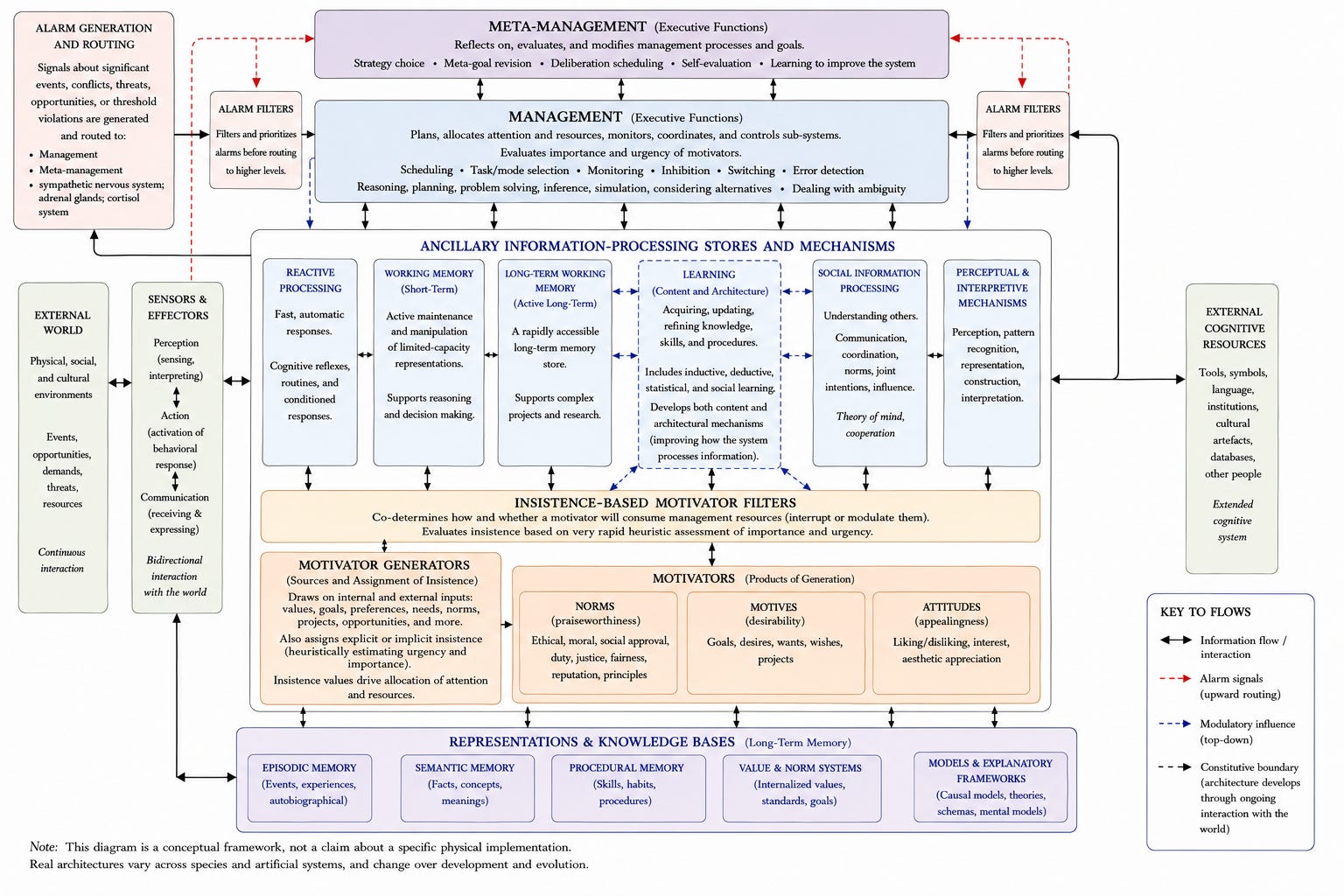
Figure 2. Human-like Autonomous Agency Architecture (HAAA): A Conceptual Overview
This figure is intentionally incomplete. It is a conceptual framework rather than a specification of a particular biological or artificial implementation. Information-processing architectures vary across species, artificial systems, individuals, and stages of development and evolution. The purpose of the diagram is to identify major architectural components and their relationships, thereby providing a conceptual map for the discussions that follow.
3.3 Allen Newell and the pursuit of unified theories of cognition
Allen Newell made architectural explanation a major research program in artificial intelligence and cognitive science. His culminating statement was Unified Theories of Cognition, based on his 1987 William James Lectures and published in 1990. Newell argued that cognitive science should aspire to theories capable of explaining cognition as the product of an integrated system rather than accumulating separate models for memory, learning, problem solving, language, and other capacities. A unified theory would not need to explain every detail immediately, but it would need to propose a common set of mechanisms capable, in principle, of operating across a substantial range of cognitive activities.
This was an important methodological proposal. A model designed to reproduce performance in one experimental task can make assumptions that would be incompatible with models of other tasks. It can also leave unspecified what happens outside the narrow phenomenon under investigation. An architecture imposes stronger constraints. The same basic mechanisms must work together across different tasks, and an explanation of one capacity must remain compatible with explanations of the others. Memory cannot be designed independently of learning, decision making, perception, and action if all of them must operate within one integrated agent. Newell’s program therefore shifted attention from constructing isolated models of particular cognitive performances toward specifying a persistent organization within which many forms of cognition could occur.
Newell presented Soar as his principal candidate for such a unified architecture. Developed with John Laird and Paul Rosenbloom, Soar was intended as an architecture for general intelligence rather than a program specialized for one problem. Its central processes included representations of current situations in working memory, long-term knowledge represented in production rules, the proposal and evaluation of operators, decision procedures for selecting among them, and the creation of subgoals when ordinary processing reached an impasse. Learning mechanisms could then convert the results of resolving an impasse into knowledge that might make future performance more efficient. The architecture thus provided a common organization for decision making, problem solving, goal-directed activity, and learning rather than supplying a separate program for each task.
The architectural research program continued beyond Newell’s original formulation. Rosenbloom later developed Sigma, an ambitious attempt at a functionally elegant, grand unified architecture for human-like intelligence. Sigma uses a common graphical foundation to integrate capabilities traditionally associated with symbolic architectures, probabilistic graphical models, and artificial neural networks. The aim is not simply to place several independently designed modules beside one another, but to derive a broad range of capabilities from the interaction of a relatively small collection of general mechanisms. Although Sigma remains a cognitive architecture and differs in scope from the information-processing framework developed in this essay, it demonstrates that Newell’s aspiration toward unified architectural explanation remains an active and evolving research program.
The distinction between an architecture and the representations contained within it is especially important. An architecture specifies relatively enduring mechanisms and constraints: what kinds of memory exist, how decisions are made, how knowledge is represented, what happens when processing encounters an obstacle, and how learning changes later behaviour. Particular skills and bodies of knowledge can then be acquired within that framework. A Soar system playing a game and another performing a planning task can contain different knowledge while relying on the same underlying architectural machinery. This separation gives an architectural theory explanatory reach beyond any one task: it proposes not merely how a particular answer is produced, but how a general kind of system can acquire and deploy many different competencies.
Newell’s call for unification also carried an important standard of theoretical accountability. A mechanism introduced to explain one phenomenon cannot be evaluated only by whether it improves performance on that phenomenon. Researchers must also ask what effects it has elsewhere in the system. Does a proposed learning mechanism remain compatible with real-time action? Does a memory system support both the retention of knowledge and its timely retrieval? Can the decision process operate when several possible activities compete? Can the architecture continue functioning as its knowledge grows? Architectural commitments create interactions, constraints, and trade-offs that disappear when psychological functions are modelled separately.
This aspect of Newell’s work is directly relevant to the present essay. A list of abilities associated with human-like intelligence—planning, language, memory, narrative, self-control, creativity, reasoning, and so forth—does not yet constitute an integrated theory. If each ability is explained by an independent mechanism without specifying how the mechanisms communicate, compete, cooperate, and share control, the resulting account may be no more than a catalogue. Human-like intelligence requires an organization in which mechanisms can operate together within one agent over time. Newell helped make that demand for integration explicit.
At the same time, Unified Theories of Cognition, Soar, and Sigma should not be treated as final specifications of human-like intelligence.
Newell referred to cognitive architectures, reflecting his primary concern with cognition. In this essay I adopt the broader term information-processing architecture because the framework developed here encompasses not only cognitive processes but also motivation, affect, management, meta-management, alarm mechanisms, and other processes that jointly determine intelligent and rational behaviour.
The greater importance of Soar and Sigma, for the present argument lies in the research strategy they exemplify: theorize about the enduring organization of a whole information-processing system; construct mechanisms precisely enough that they can be implemented; require those mechanisms to operate across multiple tasks; and evaluate individual proposals in relation to the rest of the architecture. That strategy moves cognitive science beyond correlations among measured abilities and toward explanations of how multiple capacities can be produced within a common system.
Newell’s architectural program also helps clarify why the multidimensional and architectural conceptions of intelligence must remain distinct. A multidimensional profile might quantify a system’s performance in memory, reasoning, planning, and learning. A unified architecture asks how one organized system produces all four, how those processes constrain one another, and how the system coordinates them while pursuing an activity. Newell’s work therefore did not merely add more capacities to a theory of intelligence. It sought the common organization through which diverse cognitive capacities could be realized.
The present essay adopts that commitment to integration but places it within the broader information-processing tradition most directly associated with Aaron Sloman. Human-like agents do more than solve externally supplied problems and acquire task knowledge. They generate and prioritize concerns, evaluate situations in relation to goals, norms, and preferences, respond to alarms, manage competing activities, monitor and redirect their own management processes, construct narratives, and sometimes become mentally perturbed. The importance of Newell’s contribution here is not that Soar already provides a complete architecture for all these phenomena. It is that his unified-theory program demonstrated why understanding a mind requires more than a collection of successful models: it requires an account of how diverse mechanisms can belong to and function within one integrated system.
Newell made architectural integration a prominent scientific objective. Sloman’s work pursued an even broader question: what varieties of information-processing architecture are possible, and what forms of mentality, motivation, affect, control, and autonomous agency can different architectures support?
3.4 Aaron Sloman and the broader information-processing perspective
Aaron Sloman’s work provides the most direct intellectual foundation for the architectural perspective developed in this essay. Whereas Newell made the integration of multiple cognitive functions a major scientific objective, Sloman placed the broader information-processing organization of complete agents at the centre of the explanation of intelligence and mentality. His concern was not only with how a system reasons, remembers, solves problems, or acquires task knowledge, but also with how perception, action, motivation, affect, attention and control arise within one organized system.
Incidentally: according to my literature search, Aaron Sloman was the first AI researcher to place information-processing architectures at the center of an explanation of intelligence and mentality. Chapter 6, “Sketch of an Intelligent Mechanism” of his 1978 book The Computer Revolution in Philosophy described a global information processing architecture of mind, one of the first in AI.
This broader perspective was also evident in Sloman and Monica Croucher’s seminal 1981 papers, Why Robots Will Have Emotions and You Don’t Need a Soft Skin to Have a Warm Heart: Towards a Computational Analysis of Motives and Emotions. Despite their titles, the papers were not principally attempts to add an “emotion module” to a robot. They argued that increasingly capable autonomous systems would require richer global architectures containing multiple interacting information-processing mechanisms. As such architectures became more complex, phenomena described as emotional could arise from interactions among motives, evaluations, interruptions, control processes, and competing activities. They argued that emotions would emerge from the architecture rather than needing to be added to it. The explanatory focus was therefore the global architecture of a mind rather than a collection of separately designed faculties.
The shift to architecture-based explanations of intelligence is important. It is tempting to explain an intelligent agent by assembling a list of components: a perception system, a planner, a memory store, a language system, a motivational system, and so forth. But a collection of components is not yet an architecture. The scientific challenge is to explain how those mechanisms are organized, which kinds of information they exchange, how they compete or cooperate, which processes can interrupt others, and how control changes as circumstances change. A planning mechanism that operates only when explicitly invoked belongs to a different architecture from one whose activities can be initiated, postponed, interrupted, or reconsidered by management processes. Similarly, an alarm mechanism that can influence immediate action but cannot reach higher levels of control creates different possibilities from one whose signals can also reach management or meta-management.
Sloman’s framework also made autonomous agency central. (My own thesis was on Goal Processing in Autonomous Agents.) An autonomous agent is not merely a system that solves whatever problem is placed before it. It has multiple, sometimes incompatible concerns. It must determine what deserves attention, which possible actions should be considered, which activities should be interrupted, and how limited processing resources should be allocated over time. This requires an architecture containing mechanisms for generating, evaluating, prioritizing, and managing motivators as well as mechanisms for reasoning and action. Intelligence, on this view, cannot be understood independently of the control organization within which intelligent capacities are recruited and used.
This point will become especially important when the discussion shifts from intelligence to rationality. A system may possess substantial problem-solving capacity yet deploy it poorly. It may fail to notice an important consideration, deliberate when immediate action is required, act hastily when deliberation is needed, allow an irrelevant concern to dominate attention, or persist with a strategy that should have been abandoned. Explaining such successes and failures requires more than a measure of cognitive capacity. It requires an account of how the architecture evaluates situations and manages its own processing.
Sloman’s work also encourages a careful distinction between mechanisms and the phenomena that emerge from their interaction. An alarm system, an attention filter, a motive-generating process, or a management process may be an identifiable architectural mechanism. A complex state such as mental perturbance need not be another mechanism alongside them. It may instead arise when insistent concerns repeatedly capture attention and interfere with the management of thought and action. I develop this distinction for a general audience in Why You Can’t Stop Thinking About It. The distinction matters here because not every important characteristic of an intelligent system must correspond to a dedicated box in an architectural diagram. Some of the properties we seek to understand are consequences of the organization and interaction of mechanisms.
Sloman’s architectural ideas were later expressed through increasingly elaborate schemas, including the CogAff framework and its human-oriented H-CogAff elaboration. See Sloman (2008) The Cognition and Affect Project: Architectures, Architecture-Schemas, And The New Science of Mind., which summarizes the “Cognition and Affect” research project (of which I was a founding member in 1991), and presents both the CogAff and H-CogAff schemas in an extensive discussion of information processing architectures. These distinguish broad forms of processing such as reactive, deliberative, managerial, and meta-managerial activity. I will draw selectively on these distinctions later, particularly when discussing executive functions, alarm routing, rationality, and human-like intelligence. A detailed exposition of H-CogAff is unnecessary here. Its importance for the present argument lies in demonstrating that intelligent agency may require several interacting levels of control rather than a single reasoning process or an undifferentiated “executive.” Furthermore, H-CogAff is incomplete with respect to the requirements of human-like intelligence specified in this essay.
The present essay extends this research programme in two related ways. First, it uses the architectural perspective to clarify the relationship among binary, scalar, multidimensional, and architectural conceptions of intelligence. Second, it re-addresses the question of what collection and organization of mechanisms might support specifically human-like intelligence and rationality — making contact with empirical psychology which Sloman never did. The goal is not to reproduce one historical architecture unchanged, but to identify architectural ideas that remain useful while incorporating mechanisms emphasized by subsequent research, including executive functions, narrative construction, symbol creation, self-reminding, multiple forms of value, the dynamic recruitment of processes from moment to moment, and mechanisms underlying social intelligence.
Once the organization of information processing becomes the primary explanatory object, a broader question immediately arises: how many different kinds of minds could alternative organizations make possible? Sloman pursued that question throughout his career. The next section considers his conception of the space of possible minds and the qualitative discontinuities within it.
3.5 From the Space of Possible Minds to Human-Like Intelligence
The architectural perspective naturally invites an extraordinarily broad scientific question: What kinds of minds are possible?Different information-processing architectures may support different forms of intelligence, rationality, learning, consciousness, motivation, and autonomous agency. The resulting design space is vast, encompassing biological organisms, contemporary artificial systems, hypothetical future machines, and architectures unlike any that have yet evolved or been engineered.
That broader perspective provides an essential conceptual backdrop for this essay, but it is not its principal subject. A comprehensive investigation of the space of possible minds would require comparing countless alternative architectures, many of which may bear little resemblance to human cognition. Such an undertaking lies beyond the scope of a single article.
The present essay therefore pursues a more focused objective. Rather than surveying the entire design space, it asks what distinguishes human-like information-processing architectures. Throughout the remainder of the paper, comparisons with other animals and contemporary AI are used not as ends in themselves but as points of contrast that help illuminate the distinctive organization of human-like autonomous agents.
This narrowing of scope also changes the nature of the inquiry. The question is no longer whether humans are more intelligent than other species or artificial systems according to some universal scale, nor whether they occupy the highest point on a multidimensional profile of abilities. Instead, the question becomes architectural. Which mechanisms, representations, communication pathways, forms of learning, and systems of control distinguish human-like autonomous agents? Which of these are shared with other animals? Which are shared with contemporary AI? Which combinations appear to be especially characteristic of humans?
The comparisons developed in the remainder of this essay will reveal both continuities and discontinuities. Humans share many architectural principles with other animals, reflecting our evolutionary history. Likewise, contemporary AI increasingly exhibits capabilities that overlap with aspects of human cognition, particularly in language and certain forms of reasoning. Yet similar behaviour does not imply similar architecture, just as different architectures may sometimes produce similar outward behaviour. Architectural explanation therefore requires looking beneath performance to the organization of the mechanisms that produce it.
The following section introduces the broader methodological perspective adopted throughout the remainder of the paper: an integrative design-oriented approach to autonomous agency. That perspective provides the conceptual framework within which the architectural features of human-like intelligence will subsequently be examined.
3.6 Why Intelligence Research Needs Better Theory
In “A Problem in Theory”, Michael Muthukrishna and Joseph Henrich (2019) argue that many of psychology’s current methodological difficulties—including much of the replication crisis—reflect a deeper theoretical problem. Although improved statistical practices, preregistration, larger samples, and greater transparency are valuable, they contend that these reforms alone cannot produce a cumulative science. More fundamentally, many areas of psychology lack overarching theoretical frameworks that connect empirical findings, generate principled predictions, constrain hypotheses, and explain why particular results should be expected or surprising.
Muthukrishna and Henrich contrast psychology with disciplines such as physics, chemistry, and evolutionary biology, where broad theoretical frameworks organize otherwise disconnected observations into coherent explanatory systems. Such frameworks do more than summarize empirical regularities. They identify relationships among phenomena, constrain the range of plausible explanations, guide the interpretation of new evidence, and allow surprising findings to be recognized as genuine challenges to well-established theory rather than merely unexpected experimental outcomes. Without such frameworks, psychology risks becoming what they describe as “a potpourri of disconnected empirical findings” organized more by historical accident and folk categories than by explanatory principles.
Their diagnosis aligns closely with the perspective advanced in this essay. The purpose of the present work is not to propose another dimension of intelligence, another psychometric construct, or another benchmark for evaluating AI systems. Rather, it argues that intelligence is best understood at a different level of scientific explanation: as a property of information-processing architectures. Binary classifications, scalar measures, and multidimensional profiles all characterize aspects of intelligent performance. An architectural conception seeks instead to explain why those patterns of performance occur.
Central to Muthukrishna and Henrich’s argument is the role of theory in constraining what Charles Peirce called abduction—inference to the best explanation. Faced with any interesting psychological phenomenon, researchers confront an enormous, often effectively unbounded, space of possible explanations. Theory reduces this space by identifying which explanations are plausible and which are not. As they write:
“the space of possible explanations is impossibly larger, and we cannot hope to build a cumulative science by narrowing it down with guesswork, folk intuitions, verbal logic, or our own limited life experience. A good theoretical framework helps reduce that space. Experiments are arguably the last resort after competing theoretical predictions cannot be distinguished with existing evidence…”
This observation resonates strongly with the architectural conception developed here. Throughout this paper I argue that intelligence cannot be understood by accumulating disconnected observations about behaviour or benchmark performance. The relevant explanatory challenge is to understand the space of possible information-processing architectures. Different architectures may produce remarkably similar performances, while similar architectures may exhibit different performances because of differences in knowledge, experience, motivation, learning history, or environmental support. Understanding intelligence therefore requires identifying the architectural mechanisms, representations, communication pathways, motivational organizations, learning processes, and developmental capacities that generate intelligent behaviour.
In this sense, the space of possible architectures plays a role analogous to the space of possible explanations discussed by Muthukrishna and Henrich. Architectural theory constrains explanatory possibilities by identifying classes of mechanisms that could plausibly give rise to intelligent behaviour. Rather than asking simply whether a system succeeds or fails on a benchmark, or whether it resembles humans along one or more dimensions, we ask what kinds of information-processing organization could account for the observed behaviour. This shift from performance to architecture substantially narrows the explanatory search space.
Muthukrishna and Henrich also argue that a general theory of human behaviour should be evolutionarily plausible, grounded in natural selection under phylogenetic constraints, and capable of connecting ultimate explanations with proximate mechanisms. They illustrate this approach using dual inheritance theory as an overarching framework for the behavioural sciences. Although the present essay is not itself an evolutionary theory, it is broadly consistent with this methodological perspective. Throughout the sections that follow, evolutionary considerations, drawn from Merlin Donald and others, are used to constrain the space of possible information-processing architectures and to explain why distinctively human architectural features—such as language, explanation, cumulative culture, social information processing, and meta-management—may have evolved. In this sense, the architectural conception developed here takes several steps toward the kind of evolutionarily grounded theoretical framework that Muthukrishna and Henrich advocate.
The architectural conception developed here shares these aspirations, although in a different form. It is not a mathematical theory comparable to dual inheritance theory. Rather, it is a computational theory in David Marr’s sense: a theory concerning the functional organization of intelligent systems and the information-processing mechanisms that make intelligent behaviour possible. Its objective is to characterize the architectural principles underlying intelligence, including reactive, deliberative, management, and meta-management processes; mechanisms for attention, motivation, explanation, planning, and learning; communication pathways among these mechanisms; and the developmental processes through which architectures themselves change over time.
Finally, Muthukrishna and Henrich criticize the tendency for some areas of psychology to reward clever empirical demonstrations simply because they are surprising. Surprise, they argue, should be evaluated relative to predictions derived from broader theoretical frameworks rather than relative to researchers’ folk intuitions or personal experience. I believe the same principle applies to intelligence research. Progress will come not primarily from accumulating ever more benchmark results or isolated behavioural comparisons, but from developing increasingly explanatory theories of the information-processing architectures that generate intelligent behaviour. Such theories can organize diverse empirical findings into a cumulative science while providing a principled basis for comparing humans, other animals, and artificial systems.
3.7 An Integrative Design-Oriented Approach to Autonomous Agency
The perspective adopted throughout the remainder of this essay is neither exclusively psychological nor exclusively computational. Rather, it is an integrative design-oriented approach to autonomous agency. By treating biological and artificial systems as information-processing architectures, it becomes possible to compare them within a common explanatory framework while recognizing that intelligence, rationality, cognition, affective phenomena, and many other familiar psychological phenomena emerge from the organization and interaction of underlying mechanisms. The following sections apply this perspective to develop an architectural account of human-like intelligence and rationality.
The term integrative is used here in two complementary senses. First, it is interdisciplinary. Understanding autonomous agency requires integrating insights from artificial intelligence, psychology, philosophy, neuroscience, education, psychometrics, human-computer interaction, and related disciplines. No single discipline currently provides an adequate explanatory framework. Second, it is architecturally integrative. Autonomous agents are not merely collections of cognitive processes but systems in which perceptual, motivational, affective, deliberative, executive, learning, memory, and action mechanisms continually interact. Human-like intelligence emerges from the coordinated organization of these diverse mechanisms rather than from cognition alone.
The term design-oriented reflects the methodological commitment to adopting the design stance. Rather than asking only whatmechanisms exist, it asks why they are needed, what functions they serve, how they contribute to the operation of complete autonomous agents, how they interact with other mechanisms, and how alternative architectural designs would differ in their capabilities. Information-processing architectures are therefore treated not merely as descriptive models but as explanatory hypotheses that can be analysed, compared, critiqued, and progressively improved.
Dennett coined the expression “design stance” in his 1981 paper Intentional Systems and elaborated on the stance in his 1987 book The Intentional Stance. Sloman broadened and contextualized the design stance in his 1993 AISB conference keynote paper, Prospects for AI as the general science of intelligence. He used the expression “design-based” research, which I reject to avoid confusion with the meaning of “designed based” in social sciences. I use the expression “design-oriented” as an adjective for the design stance.
The explanatory target of integrative design-oriented research is autonomous agency itself. By autonomous agency I mean the capacity of an information-processing system to generate, evaluate, prioritize, pursue, suspend, revise, and abandon its own motivators while responding adaptively to changes in both its external environment and its internal state while subject to temporal and resource constraints. Explaining autonomous agency therefore requires considerably more than explaining perception, memory, reasoning, or decision making in isolation. It requires understanding how complete architectures organize, coordinate, monitor, and regulate the many mechanisms that collectively enable intelligent behaviour over extended periods of time.
This emphasis distinguishes the present work from many approaches within psychology and cognitive science. Much psychological research seeks to explain particular phenomena, such as behaviour, cognition, subjective experience, or affective phenomena. Agnes Moors, for example, argues that psychological theories should clearly identify the phenomenon to be explained before specifying the information-processing mechanisms responsible for it (e.g., Moors, 2017; Moors, 2026). Her recent work further argues that emotions do not constitute a distinct scientific kind requiring dedicated emotion mechanisms but are better understood as emerging from general-purpose goal-directed processes. I am in substantial agreement with this eliminativist perspective.
My own work has used the integrative design-oriented perspective since the early 1990s, including for instance my Ph.D. dissertation, Goal Processing in Autonomous Agents, my work on the sleep onset control system, and my work on cognitive productivity.
The relationship between the present work and Moors’ research programme is therefore one of explanatory scope rather than fundamental theoretical disagreement. Whereas Moors seeks to explain phenomena commonly described as emotions in terms of general-purpose goal-directed mechanisms, the present work seeks to explain the information-processing architecture of autonomous agents, including goal processing but also other mechanisms. Behaviours, reasoning, intelligence, rationality, affective phenomena, executive functions, narrative construction, and many other familiar psychological phenomena are treated as manifestations of the organization and interaction of underlying mechanisms rather than as independent explanatory targets.
This methodological perspective has several important consequences for the remainder of the paper.
Explanatory priority is given to the organization of complete autonomous agents rather than to isolated cognitive functions.
Mechanisms are distinguished from the higher-level phenomena that emerge from their interaction. An attention filter, an alarm mechanism, a management process, a memory system, or a motive generator may be identifiable architectural components, whereas perturbance, intelligence, rationality, and many other familiar psychological phenomena are better understood as emergent properties of the coordinated operation of those mechanisms.
The same explanatory framework can be applied to humans, other animals, artificial systems, and hybrid human-AI systems, allowing meaningful architectural comparisons across all of them.
This integrative design-oriented perspective provides the methodological foundation for the remainder of the paper. The following sections examine the architectural organization of human-like autonomous agents, identifying the mechanisms and principles that distinguish them from other animals and from contemporary AI, while recognizing that all three occupy different regions of the broader space of possible minds.
4. Architectural Innovations Underlying Human-Like Autonomous Agency Through Evolution
The preceding sections argued that intelligence is best understood in terms of information-processing architectures rather than binary categories or psychometric dimensions, and introduced an integrative design-oriented approach to autonomous agency as the methodological perspective adopted throughout this paper. The next question is therefore straightforward: what architectural innovations distinguish human-like autonomous agents from other animals and from contemporary AI?
The purpose of this section is not to propose a comprehensive theory of the evolution of information-processing architectures. Such a theory does not yet exist, and constructing one remains a major challenge for cognitive science, artificial intelligence, evolutionary psychology, comparative cognition, neuroscience, and related disciplines. Nor does this paper claim to explain how every architectural mechanism discussed later evolved. Nevertheless, considerable progress has been made toward identifying many of the functional requirements that a human-like autonomous architecture must satisfy, many of the information-processing mechanisms capable of satisfying those requirements, and many of the causal relationships among those mechanisms. Thus, although we lack a complete evolutionary account of architectures such as H-CogAff, we possess an increasingly rich understanding of many of their functional organization and architectural principles.
This distinction between evolutionary and architectural explanation is fundamental. Evolutionary explanations seek to account for how architectures arose through natural selection and other evolutionary processes. Architectural explanations seek to account for how those architectures function once they exist. The two explanatory enterprises are therefore complementary rather than competing. Evolution explains how architectural innovations emerged; architectural analysis explains how those innovations collectively enable autonomous agency.
An especially useful account of the evolution of human cognition is Merlin Donald’s A Mind So Rare: The Evolution of Human Consciousness (Donald, 2001). Donald argues that uniquely human consciousness did not arise through a single evolutionary breakthrough, but through the gradual accumulation and convergence of multiple architectural innovations, each extending the capabilities of earlier forms of cognition. In an email to me, Donald has suggested that his framework may be regarded as a multiple-component convergence theory of consciousness, emphasizing that human conscious integration emerged through the convergence of multiple independently evolving capacities rather than from a single specialized mechanism. This perspective is highly compatible with the architectural approach adopted in the present paper.
Following Donald, the discussion begins with three major evolutionary transitions that successively expanded the capabilities of the human information-processing architecture.
The mimetic transition. This transition introduced voluntary control over action, gesture, pantomime, whole-body imitation, increasingly sophisticated skill acquisition, rehearsal, self-reminding, and other capacities that greatly expanded behavioural flexibility. Donald argues that these innovations enabled humans to learn, refine, and transmit increasingly complex behavioural repertoires, thereby laying important foundations for cumulative culture.
The mythic transition. The emergence of language enabled narrative thought, storytelling, story comprehension, shared myths, cultural memory, and new forms of social coordination. Narrative became a powerful mechanism for organizing experience, transmitting knowledge, constructing identity, communicating norms, and supporting increasingly sophisticated cooperation. This transition therefore transformed not only communication but also the organization of memory, planning, reasoning, and collective cognition. Donald’s account of mythic consciousness is complemented by contemporary work on the psychology of narrative, particularly that of Will Storr. Storr argues that storytelling is not merely a form of entertainment or communication, but a fundamental mode of human cognition through which people organize experience, construct identities, understand others’ motives, transmit values, and coordinate social behaviour. His analyses provide a valuable psychological perspective on why the mythic transition represented such a profound architectural innovation (Storr, W. (2019). The Science of Storytelling: Why Stories Make Us Human, and How to Tell Them Better; Storr, W. (2025). A Story Is a Deal: How to Use the Science of Storytelling to Lead, Motivate and Persuade).
The theoretic transition. The invention of external symbolic representations—including writing, mathematics, diagrams, scientific notation, and other cognitive technologies—fundamentally altered the architecture of human cognition. Knowledge could now be accumulated, externally represented, refined across generations, and retrieved in increasingly flexible ways. Donald further emphasizes that these developments dramatically expanded human cognition through external cognitive scaffolding, creating retrieval opportunities and knowledge-building capacities that far exceed those available to unaided biological memory. Contemporary knowledge technologies—including digital libraries, search systems, hypertext, contextual information retrieval, and AI— continue this long evolutionary trajectory. External symbolic representations extend human consciousness (cf. the extended mind thesis).
Donald refers to the theoretic transition as “the great hominid escape”. He contrasts engrams, representations in the mind (I’d say virtual machine) and exograms, representations in the world (World 3).
The former are impermanent, small, hard to refine, impossible to display in awareness for any length of time, and difficult to locate and recall. In fact, to find a natural memory, we tend to rely on ancient associative principles such as similarity and contiguity. In contrast, external symbols give us stable, permanent, virtually unlimited memory records that are infinitely reformable and more easily displayed to awareness.
Donald’s account of the mimetic, mythic, and theoretic transitions provides a powerful evolutionary perspective on the emergence of human cognition. Rather than attributing human consciousness to a single evolutionary innovation, he argues that it emerged through the gradual accumulation and convergence of multiple architectural innovations over evolutionary time. However, his account is primarily evolutionary rather than architectural in the sense developed in this paper. The goal here is therefore not to replace Donald’s framework, but to build upon it by examining the architectural requirements and mechanisms that underlie these evolutionary innovations.
Donald’s analysis extends beyond these three transitions. In A Mind So Rare, he distinguishes three progressively more powerful levels of conscious integration: Level 1 awareness, involving sensory binding; Level 2 awareness, supporting short-term control; and Level 3 awareness, supporting intermediate- and long-term governance. While the first two have deep evolutionary roots, the third underwent remarkable elaboration in humans and provides the functional basis for long-term planning, narrative organization, self-reminding, knowledge building, external cognitive scaffolding, and other forms of autonomous agency. Donald’s emphasis on wide temporal integration and long-term governance complements the architectural perspective developed in the present paper, in which autonomous agency depends upon mechanisms capable of coordinating behaviour across extended timescales.
Donald’s framework also provides a natural bridge between evolutionary and architectural explanations. Evolution explains how these successive innovations emerged, whereas information-processing architectures seek to explain the mechanisms that enable them to function. The remainder of this section therefore extends Donald’s analysis by considering additional architectural innovations and requirements that have become increasingly prominent in subsequent research, including expanded executive governance, metacognition, cooperation, knowledge construction, productive practice, and other developments that collectively distinguish human-like autonomous agents from other animals and contemporary AI. These innovations should not be regarded as isolated faculties or modules. Rather, they represent interacting architectural developments whose coordinated operation gives rise to the distinctive capabilities of human autonomous agency.
For the purposes of the present paper, Donald’s account serves as the principal evolutionary framework for understanding the emergence of human consciousness. It is particularly valuable because it is functional, explicitly multi-component, architecturally oriented, and readily integrated with information-processing approaches to autonomous agency.
5. Architectural Mechanisms Underlying Human-Like Autonomous Agency
The preceding section identified evolutionary innovations and functional requirements associated with human-like autonomous agency. The next task is architectural: what kinds of information-processing mechanisms could enable an agent to satisfy those requirements? This does not imply that every familiar psychological capacity corresponds to a distinct mechanism. Narrative cognition, cooperation, metacognition, rationality, intelligence, and productive practice are better understood as higher-level capabilities or emergent properties produced by interactions among multiple mechanisms distributed across an information-processing architecture.
The perspective developed here draws especially on Aaron Sloman’s work on complete autonomous agents and the H-CogAff framework, together with my own work on motive processing, management, meta-management, alarm mechanisms, insistence, and mental perturbance. H-CogAff should not be treated as a finished or uniquely correct model of the human mind. It is better understood as a design-oriented framework for identifying kinds of processing, the organizational problems they solve, and the interactions that may be required within a complete autonomous agent. Its value lies less in providing a definitive inventory of mechanisms than in drawing attention to architectural distinctions that are obscured when intelligence is represented only by psychometric variables or isolated cognitive functions.
5.1 Reactive processing, management, and meta-management
One of the most important architectural distinctions is between reactive processing and higher-level forms of control. Some behaviour can be generated through relatively direct couplings among perception, internal states, and action. Reactive processing can be rapid, highly adapted to recurring circumstances, and effective without constructing and comparing alternatives. Reactive processes includes cognitive and behavioral reflexes, asynchronously generating motivators, and generating alarms — capabilities which are discussed below.
An agent restricted to reactive processing, however, would have difficulty considering hypothetical futures, resolving conflicts among motivators, coordinating multiple projects, governing behaviour over extended periods, or deliberately improving how it thinks and acts.
Human-like autonomous agency therefore requires at least two further classes of process:
Management processes perform higher-level cognitive work involved in pursuing and coordinating motivators. They may interpret situations, retrieve relevant information, construct and compare alternatives, reason about consequences, formulate plans, make decisions, schedule activities, resolve conflicts, initiate and terminate lines of thought, monitor progress toward current objectives, and revise action when circumstances change. Deliberation is therefore included within management rather than standing beside it as a separate architectural category. It is a form of management in which alternatives, interpretations, consequences, or plans are represented and assessed. Not every management process need be deliberative: some may use learned procedures, heuristics, or rapid judgments without an extended comparison of explicitly represented alternatives.
Meta-management processes monitor, evaluate, prioritize, and regulate management processes. They may allocate attention among competing management activities, determine which problems or motivators warrant sustained consideration, interrupt or redirect an ongoing line of thought, detect that a deliberative strategy is ineffective, identify recurrent biases or errors, and assess whether current methods of reasoning and control remain appropriate. Meta-management may also evaluate more enduring patterns in the agent’s cognitive life—for example, whether attention is repeatedly captured, whether important projects are habitually neglected, or whether characteristic patterns of motivation and response should be modified. It therefore contributes to metacognition, reflection, self-evaluation, attentional control, and deliberate self-modification.
The distinction is not between processes that monitor and processes that do not. It concerns the object of monitoring. Management may monitor the progress of an activity or plan relative to its objective; meta-management monitors and regulates how management is conducting that activity, including whether its strategy, allocation of effort, reasoning, or mode of control should be changed.
The term executive functions can be used broadly to encompass both management and meta-management processes. On this view, executive functions should not be reduced to the influential triad of inhibition, working memory, and cognitive flexibility. Those capacities are important, but the executive organization of a human-like autonomous agent also includes planning, scheduling, prioritization, evaluation, decision-making, interruption management, ambiguity handling, self-monitoring, strategy assessment, and the direction of both reactive and deliberative processing.
These processes need not operate in a rigid sequence. Reactive processing, management, and meta-management may operate concurrently and influence one another. A deliberative management process may be initiated, prioritized, monitored, interrupted, redirected, or terminated by meta-management. Reactive and alarm processes may alter the priorities of management or meta-management. Individuals with broadly similar architectures may therefore behave very differently depending on which processes are engaged, what information is accessible, which motivators are insistent, and how effectively their activities are governed.
5.1.1 Stanovich’s Distinction Between Intelligence and Rationality
Keith Stanovich’s distinction between intelligence and rationality fits naturally within the architectural perspective developed here. Throughout a series of influential books—including What Intelligence Tests Miss: The Psychology of Rational Thought, Rationality and the Reflective Mind, and The Bias That Divides Us: The Science and Politics of Myside Thinking—Stanovich argues that conventional intelligence tests measure important computational capacities but fail to capture whether those capacities are deployed rationally. High intelligence does not guarantee sound judgment, open-mindedness, careful evaluation of evidence, or effective decision making.
From an information-processing architectural perspective, this distinction is readily understood. Intelligence concerns the capabilities of an architecture: the ability to reason, plan, remember, learn, construct explanations, or solve problems. Rationality concerns how those capabilities are governed, coordinated, evaluated, and brought to bear on particular situations. An architecture may possess sophisticated reasoning mechanisms while deploying them poorly because of failures in motivation, attention, evaluation, or executive control. Conversely, improvements in management and meta-management can increase rational behaviour without necessarily increasing basic computational capacity.
Stanovich’s distinction between the algorithmic mind and the reflective mind, influenced in part by Sloman’s H-CogAff framework, also maps naturally onto the present framework. The algorithmic mind encompasses many of the computational processes responsible for reasoning and problem solving, whereas the reflective mind concerns the goals, standards, dispositions, and monitoring mechanisms that determine whether those computational resources are used appropriately. Although the correspondence is not exact, the reflective mind overlaps substantially with what I describe here as managementand especially meta-management. These mechanisms determine not merely how to solve a problem, but whether to deliberate, which standards of evidence to adopt, when to reconsider an assumption, whether to seek criticism, and when to abandon an unproductive line of thought. Stanovich also emphasizes the importance of cognitive decoupling—the capacity to construct and evaluate hypothetical possibilities without immediately committing to them. From an architectural perspective, this is an important capability supported by deliberative management mechanisms.
This perspective also explains why rationality depends upon architecture-based motivation. Sound reasoning requires more than computational ability. It depends upon effectance-related dispositions such as curiosity, concern for explanatory adequacy, willingness to revise beliefs, openness to criticism, and the persistence needed to resolve uncertainty. These are not simply abstract intellectual virtues; they are realized through patterns of motivator generation, motivator evaluation, insistence, management, and meta-management that determine how cognitive resources are allocated over time.
Finally, Stanovich’s work provides independent support for one of the central themes of this paper: explaining rationality requires more than measuring performance. Just as intelligence is better understood as a property of information-processing architectures than as a binary category, scalar quantity, or multidimensional profile, rationality is better understood in terms of the architectural organization that governs the deployment of intelligence. The distinction between intelligence and rationality therefore lends further support to the architectural conception developed throughout this essay.
5.2 Motivator generation, evaluation, and control
Autonomous agency requires more than the ability to solve externally specified problems. An autonomous agent must generate, adopt, assess, prioritize, pursue, suspend, revise, and abandon its own motivators. The term motivator is useful because it encompasses more than conventional goals. Goals don’t necessarily have motivational insistence (attentional priority) or intensity (behavioral propensity) as discussed briefly below. Wants and desires, which we call motives, do. Moreover, human agents are influenced not only by desired outcomes and projects, but also by norms, commitments, needs, preferences, aversions, identities, values, and commitments to others. These sources of motivation can conflict, vary in urgency, importance, insistence and intensity and operate across radically different timescales.
A complete architecture therefore requires mechanisms that generate candidate motivators (motivator generators) and mechanisms that evaluate them (motivator evaluators). Motivator generators may respond to environmental changes, internal needs, remembered commitments, perceived threats or opportunities, social expectations, and ongoing projects. Motivator evaluators may assess importance (expected benefit, cost, risk), urgency (temporal considerations), feasibility, moral or social acceptability, compatibility with other commitments, and consequences for longer-term projects. Most of these dimensions are discussed in detail in my thesis.
Some evaluations may be rapid and largely automatic (insistence and intensity); others may require deliberation or reflection. Motivational control is therefore not the operation of a single faculty. It emerges from interactions among motivator generators, motivator evaluators, memory, management, meta-management, and action-control processes. A motivator may be generated without being adopted (just a wish), adopted without being acted upon, or acted upon without extensive reflective (management) assessment.
This architecture also explains why rationality cannot be identified simply with reasoning ability. An agent may reason competently yet repeatedly fail to pursue what it judges to be important. Conversely, it may possess powerful motivation but lack the capacity to assess evidence, anticipate consequences, or regulate impulsive responses. Human-like rationality depends on both cognitive capacities and a motivational substrate capable of directing those capacities toward appropriate ends. Intelligence, rationality, and autonomous agency therefore overlap, but they should not be treated as interchangeable.
The architecture must also explain how motivators gain access to limited processing resources. My own work and Sloman’s uses insistence to characterize a motivator’s disposition to attract attention or interrupt ongoing processing. Insistence is not equivalent to conscious desire, subjective importance, or emotional intensity. It is an architectural property affecting whether and how a motivator gains access to management and other scarce resources. This distinction explains why some concerns repeatedly intrude despite an agent’s reflective judgment, whereas other acknowledged priorities fail to influence behaviour.
5.3 Alarm mechanisms, attention, interruption, and perturbance
Human-like autonomous agents operate in environments too complex and dynamic for every relevant process to remain under continuous supervision. Their architectures therefore require mechanisms capable of detecting potentially important developments and rapidly redirecting processing. Alarm mechanisms constitute one such class. They may respond to danger, opportunity, error, conflict, novelty, or significant deviation from expectation and alter the priorities of other parts of the architecture.
An alarm reaction is the first stage of Hans Selye’s stress response, in his seminal 1936 paper which introduced the concept of stress. As I discussed here the term is surprisingly rarely (but sometimes) used in psychology. Clinicians have identified alarms with activity of the amygdala:
The intrusive thoughts toolkit: quick relief for obsessive, unwanted, or disturbing thoughts and
Rewire Your Anxious Brain: How to Use the Neuroscience of Fear to End Anxiety, Panic, and Worry
However, a neuroscience account is insufficient. A design-oriented account is also required and has been proposed by Aaron Sloman, and I have followed up on it (e.g., in this paper on mental perturbance, and this paper on sleep onset and insomnolence.)
Sloman referred to alarms as primary emotions. We avoid using the term “emotion” because definitions and theories of emotion are too numerous, diverse and somewhat contradictory. We agree with Moors that emotions are best thought of descriptively. See her target article in this month’s issue of Emotion Review: Emotions as High-Impact Decisions: A Goal-Directed Theory.
Architectures may differ qualitatively in how alarm mechanisms are triggered, what information they monitor, where their signals are routed, and how strongly they influence ongoing activity. An alarm routed toward action systems may produce an immediate response. One routed to management may interrupt a current activity and initiate reassessment. One reaching meta-management may prompt evaluation of the agent’s current strategy or recurrent pattern of response. Differences in routing can therefore produce substantial differences in autonomy and intelligence even when the same alarm-triggering information is available.
Attention mechanisms should likewise not be treated as a single scalar capacity. An architecture may contain multiple filtering, selection, orienting, maintenance, and switching mechanisms. Some affect which perceptual information becomes available for further processing; others affect which memories are retrieved, which motivators are considered, or which management processes remain active. Meta-management may regulate the allocation of attention among competing management activities, but attentional selection also occurs at other levels of the architecture.
Interruption mechanisms are essential because no fixed plan can anticipate every relevant development. Yet excessive or poorly regulated interruption, as seen in obsessive-compulsive disorder and pathological limerence (romantic obsession), can make sustained activity impossible. Effective agency therefore depends not merely on responsiveness but on regulating responsiveness: determining which signals justify interruption, which can be deferred, and how an interrupted context can later be reconstructed.
Mental perturbance illustrates why mechanisms must be distinguished from emergent phenomena. Mental perturbance is not itself a mechanism located in the architecture. It arises when an insistent motivator repeatedly gains, or threatens to gain, control of management despite processes attempting to sustain other activity. Rumination, preoccupation, intrusive concern, and certain affective episodes may consequently emerge from interactions among motivators, insistence, alarms, attention, management, and meta-management. This kind of explanation avoids treating a familiar psychological category as though it were a unitary internal component. Perturbance was originally called emotion in Sloman & Croucher (1981): You Don’t Need a Soft Skin to Have a Warm Heart: Towards a Computational Analysis of Motives and Emotions. I changed the name to perturbance to avoid needless debates about what the term “emotion” should refer to technically. (cf. Izard 2010 on such terminological debates.)
5.4 Memory, self-reminding, and governance across time
Consciousness is typically felt to be immediate awareness, identified with sensory and working memory. However, as Merlin Donald emphasized, human-like autonomous agency requires governance across timescales far exceeding the duration of working memory. An agent may form intentions concerning events hours, months, or decades in the future. It may need to suspend one project, resume another, preserve commitments through changing circumstances, and retrieve relevant knowledge at the appropriate moment.
Working-memory mechanisms are important but insufficient. Extended governance also depends on long-term memory mechanisms, including what K. Anders Ericsson called long-term working memory, prospective-memory mechanisms, self-reminding mechanisms, and contextual retrieval mechanisms. Self-reminding is especially important because an intention that cannot re-enter processing at the appropriate time has little power to govern behaviour. Human agents use both internal and external means to bridge discontinuities in attention and consciousness.
The problem is not merely storing information but accessing the right information when it becomes relevant. Contextual retrieval mechanisms exploit cues provided by tasks, environments, motivators, social interactions, and external representations. Failures of access can produce failures of reasoning and action even when the required knowledge remains stored in long-term memory. Intelligence therefore depends partly on an architecture of access: the mechanisms and scaffolds through which knowledge becomes available to ongoing activity. At my company, CogSci Apps Corp., we developed Hookmark app to facilitate contextual information retrieval.
Long-term governance thus also requires context-reinstatement mechanisms. When an activity is resumed, the architecture must recover not only its broad objective but enough of its prior context to continue effectively: what has already been accomplished, what remains unresolved, which resources are relevant, and what should happen next. Human agency is possible partly because projects and commitments can be reactivated across discontinuous episodes of conscious processing.
Donald later broadened this argument by proposing that human cognition is fundamentally embedded within distributed cognitive-cultural networks, in which external symbolic resources—including writing, books, and computers—become integral components of the cognitive system rather than merely aids to memory. (See Donald (2007) The slow process: A hypothetical cognitive adaptation for distributed cognitive networks).
5.5 Learning, explanation, and architectural development
Human-like agents do not merely adapt through immediate reinforcement. They can observe, imitate, rehearse, seek and use feedback, construct explanations, criticize their own representations, and deliberately improve patterns of thought and action. These capacities depend on interactions among learning mechanisms, memory, motivation, management, and meta-management.
I use the concept of productive practice — which I developed extensively in my two Cognitive Productivity books — for deliberate activities intended to produce useful and relatively enduring changes not merely in knowledge, skill but also in habits, motivation, and cognitive architecture. Such practice may build semantic and procedural knowledge, long-term working memory, new monitors and motivators, and improved forms of management and meta-management. Explanation, criticism, and error correction can likewise reorganize knowledge and improve the processes through which later learning occurs.
Because learning is central enough to require fuller treatment, Section 6 examines it as architectural change, including sample efficiency, productive practice, explanatory criticism, and meta-effectiveness.
5.6 External cognitive scaffolding
As Merlin Donald emphasized more than others, human consciousness is not confined to biological memory and internal processing. Writing, diagrams, mathematical notation, books, databases, search systems, and digital tools alter what humans can represent, preserve, inspect, revise, and retrieve. External-memory systems preserve information beyond the limits of biological memory. External-representation systems make complex relations available for sustained inspection and manipulation. Retrieval systems and contextual information-retrieval systems help reconnect stored resources with the activities in which they are relevant.
These systems can extend long-term governance, reduce demands on working memory, support comparison and reflection, and enable cumulative knowledge building. They can also generate distraction, fragmentation, and loss of context. Their contribution therefore depends on how they interact with motivator processing, management, meta-management, memory, and attention. The relevant unit of analysis may sometimes be a dynamically organized human-tool system, not the unaided individual.
The principles of Cognitive Productivity describe strategies for making effective use of such architectures and scaffolds. They are not themselves internal mechanisms, but practices available to agents capable of knowledge-guided self-governance, contextual retrieval, metacognition, and productive learning.
These mechanisms are biologically unique to human intelligence, but modern AI shares similar competence, though implemented quite differently from human architectures.
5.7 Social Information-Processing Mechanisms
A defining characteristic of the human information-processing architecture is its extensive support for social cognition and social coordination. Humans do not merely interact socially more often than other animals; they possess architectural mechanisms that enable cooperation, division of labour, shared intentions, long-term commitments, institutions, and cumulative culture. These capabilities are central to human intelligence.
As Jonathan Haidt argues in The Righteous Mind, humans are uniquely capable of organizing into “superorganisms” that cooperate at scales far beyond close kinship. Likewise, Michael Tomasello has argued that humans exhibit group-mindedness: the capacity to form shared intentions, learn and enforce social norms, share group-related emotions, and construct enduring social institutions.
Merlin Donald likewise argues that human minds develop only within symbolic cultures and that culture supplies many of the algorithms, retrieval paths, attentional routines, and symbolic practices that constitute mature human cognition. Human intelligence is therefore inherently both individual and distributed. (See Donald (2007) Evolutionary origins of the social brain)
Donald brilliantly explains how human cognition became increasingly dependent on external symbolic culture. The present account asks a complementary question: what architectural properties make such cultural participation possible in the first place?
Human-like intelligence also depends on specialized mechanisms for processing social signals. Much of the information humans exchange concerns not only the external world but also competence, trustworthiness, commitment, status, intentions, affiliations, and reputation. Such information guides cooperation, competition, mate selection, coalition formation, leadership, and other forms of social interaction. From an architectural perspective, social signaling is therefore an important form of information processing rather than merely a category of behaviour.
This perspective is consistent with several influential accounts of human cognition. Geoffrey Miller’s The Mating Mind (2000) argues that many human cognitive abilities evolved partly because they function as signals of intelligence and fitness during mate selection. Kevin Simler and Robin Hanson’s The Elephant in the Brain (2018) emphasizes that much human behaviour serves hidden social functions by signaling desirable qualities to others, while Will Storr’s The Status Game (2021) argues that the pursuit and negotiation of social status is a pervasive feature of human life. Regardless of the specific evolutionary explanations, these accounts converge in highlighting the importance of sophisticated social information-processing mechanisms in human-like intelligence.
From an architectural perspective, these capacities require specialized information-processing mechanisms. Human architectures must represent social relationships, commitments, reputations, obligations, trust, norms, coalitions, and institutions, while continually monitoring and updating these representations during social interaction. Such mechanisms extend far beyond the processing required for individual survival goals.
Michel Aubé has proposed an especially illuminating architectural account. Whereas many motivational systems regulate resources such as food, water, or safety, Aubé argues that humans possess motivational machinery specifically concerned with commitments as a distinct class of resources. Commitments—to individuals, groups, organizations, projects, and institutions—become objects of perception, evaluation, planning, and emotional regulation. His ideas are developed in A Commitment Theory of Emotions (1998) and Beyond Needs: Emotions and the Commitments Requirement (2005). I have summarized this perspective in On the Relationship-building Proclivities of Human Nature.
These architectural mechanisms also have profound affective consequences. Commitments create new forms of vulnerability because threats to relationships, obligations, identities, and institutions become potential sources of concern. This perspective aligns with the architectural analyses of emotion developed by Wright, Sloman, and Beaudoin in Towards a Design-Based Analysis of Emotional Episodes, and with later work on mental perturbance. (I now prefer the term design-oriented rather than design-based to avoid confusion with the design-based research methodology.)
Finally, these social architectures are deeply intertwined with humanity’s external symbolic environment. Language, writing, mathematics, science, law, digital technologies, and other external symbol systems are fundamentally social achievements. They correspond closely to Popper’s notion of World 3: the objective products of human knowledge that both arise from and transform our information-processing architectures.
A full architectural account of social information processing lies beyond the scope of this paper. Nevertheless, these mechanisms illustrate an important general point. Human intelligence is not solely an individual capacity for reasoning or problem solving. It also depends upon architectural mechanisms for representing, maintaining, negotiating, and regulating the social relationships and commitments that make cumulative culture, institutions, and large-scale cooperation possible.
5.8 From evolutionary innovations to architectural mechanisms
Donald’s evolutionary account and H-CogAff-style architectural analysis address different but complementary questions. Donald identifies major evolutionary transitions and functional reorganizations, including the expansion of voluntary control, narrative and cultural coordination, wide temporal integration, and external symbolic scaffolding. Architectural analysis asks what mechanisms and information flows could realize such capacities within autonomous agents.
However, a comprehensive mapping between Donald’s architectural concepts and H-CogAff does not yet exist. We do not know in sufficient detail which changes in memory, motor control, motivator processing, management, meta-management, or social cognition enabled each evolutionary transition, nor how older mechanisms were reorganized into the multiple-component convergence characteristic of human cognition. Constructing such mappings is an important research programme, but it lies beyond the scope of this paper.
The present aim is more limited: to distinguish evolutionary innovations, architectural requirements, mechanisms, and emergent capabilities, and to show how they can be connected to achieve human-like intelligence without collapsing them into one explanatory level. Donald helps identify what evolved and what new forms of organization became possible. H-CogAff and related design-oriented frameworks help formulate hypotheses about how such organization might work.
Now we are well positioned to understand that the mechanisms considered cannot adequately be characterized by a single numerical measure of intelligence. They reveal qualitative differences in how agents generate and evaluate motivators, manage and meta-manage their activities, respond to alarms, govern behaviour across time, learn through practice, and extend cognition through external scaffolds.
6. Learning, Architectural Change, and Meta-Effectiveness
The preceding section identified several classes of mechanism required by human-like autonomous agents: reactive, management, and meta-management processes; motivator generators and evaluators; attention and alarm mechanisms; multiple forms of memory; self-reminding; and systems for governing activity across extended periods. These mechanisms do not remain completely fixed throughout the lifetime of an agent. Human-like intelligence depends partly on their capacity to acquire new contents, procedures, connections, dispositions, and forms of organization.
Intelligence is often defined partly in terms of an ability to learn. That formulation is correct but radically underspecified. It does not tell us what changes when learning occurs, what kinds of mechanisms produce those changes, whether every part of an architecture is equally modifiable, or whether an agent can deliberately influence its own development. From an architectural perspective, learning is not one process that transfers information into long-term memory. It is a heterogeneous family of processes capable of changing many different parts of an information-processing system.
The most consequential forms of learning can be recursive. An architecture may acquire not only new knowledge or skills, but also improved ways of learning, explaining, evaluating, practising, managing attention, and regulating its own activity. I will use recursive architectural development for this capacity of an architecture to improve some of the mechanisms through which it subsequently learns, reasons, acts, and develops. Productive practice, criticism, error correction, and meta-effectiveness are important manifestations of this broader process.
6.1 Learning as architectural change
Marvin Minsky provided an unusually rich illustration of the diversity of learning in his seminal 1985 book, The Society of Mind. Learning may involve forming new condition–action rules, changing low-level connections, creating subgoals, selecting better search procedures, revising high-level descriptions and narratives, constructing suppressors and censors that prevent recurrent errors, linking previously separate fragments of knowledge, developing new analogies, and constructing new models, virtual worlds, and other forms of mental representation.
The importance of this catalog is not that it is exhaustive. No finite catalog could enumerate every possible type of architectural change. Its importance is that it demonstrates why learning cannot be understood adequately through the familiar distinction among sensory memory, short-term memory, and long-term memory. Those distinctions concern the duration or location of information retention. They do not specify the many kinds of representation, procedure, evaluation, motivation, control, and organization that learning may alter.
Minsky emphasized that intelligence arises from societies of interacting mechanisms. The present account extends this architectural perspective by proposing a framework for comparing entire information-processing architectures across humans, non-human animals, and AI systems.
An architectural account can extend Minsky’s catalog. Learning may produce new motivator generators and alarm mechanisms for instance. Learning may alter how attention is allocated, how underlying relevant memories are retrieved, how deliberation is scheduled, how interruptions are handled, or how unresolved activities are resumed. It may produce new monitors capable of detecting errors, conflicts, opportunities, or recurrent patterns of failure.
Learning may also alter an agent’s motivational architecture. New motivator generators may be acquired, causing situations that were previously motivationally inert to generate new norms, new preferences, new goals, new desires (types of goals), and new needs. Motive comparators and other evaluative processes may be revised. Insistence-assignment rules may change, altering which concerns attract attention or interrupt ongoing activity. Agents may acquire new moral or professional norms, preferences (attitudes), commitments, aversions, standards of evidence, and criteria of importance. They may learn not only how to achieve an existing goal but what to care about, what to notice, what to question, and what kinds of errors should provoke investigation. These forms of motive processing, evaluation, insistence, management, and meta-management are discussed in more detail in my doctoral dissertation, Goal Processing in Autonomous Agents.
At higher levels, learning may modify management and meta-management (i.e., executive processes). An agent may acquire better ways of framing problems, selecting strategies, allocating effort, evaluating evidence, detecting fixation, handling ambiguity, or deciding when further deliberation is warranted. It may learn to recognize characteristic failures in its own reasoning and to intervene when those patterns recur. It may also develop better methods for organizing its learning, thereby changing not only its knowledge and skills but the processes through which future knowledge and skills will be acquired.
A useful broad taxonomy is therefore that learning may alter:
representations and stored knowledge;
procedures, skills, and strategies;
evaluative and monitoring mechanisms;
motivational mechanisms and dispositions;
management and meta-management processes;
communication pathways and patterns of interaction among components.
These categories overlap. A newly acquired norm, for example, may be represented as knowledge, generate new motivators, alter evaluation, and influence meta-management. Learning commonly reorganizes several parts of the architecture at once.
6.2 Sample Efficiency and Architectural Learning
One of the most revealing comparisons between humans and contemporary AI concerns sample efficiency: how much experience is required to acquire a new capability. Current AI systems often require enormous quantities of training data to achieve levels of performance that humans can sometimes attain after only a handful of examples, or even a single explanation. Sample efficiency is therefore not merely another performance metric. It reflects important properties of the underlying information-processing architecture.
In contrast, human learning is highly sample efficient because new information is interpreted a much richer architecture, leveraging the three forms of consciousness detailed by Merlin Donald, discussed above. New experiences rarely stand alone. They are integrated with extensive prior representations, retrieved memories, explanatory models, and external cognitive resources. A child who learns a new word, a scientist who understands a new theory, or a physician who recognizes an unfamiliar disease is not simply storing another isolated item in memory. Existing architectural organization allows a relatively small amount of experience to produce widespread changes in understanding and future behaviour.
That is to say that a major limitation of contemporary AI systems is the enormous amount of data required to acquire their general capabilities. The best popular discussion of this issue that I have found is Dwarkesh Patel’s The data black hole at the center of AI. I recommend the article and associated video. Here’s part of what he says:
It is easy to forget how much data these models are trained on, and how much more it is than what we humans see in our lifetimes. We see these AIs as a galaxy glittering with capabilities, but at their center, invisible to the naked eye, holding all the constellations together, is an unimaginably massive black hole of data.
This observation illustrates why sample efficiency belongs in an architectural conception of intelligence. The issue is not simply how much data a system consumes, but why it requires that amount of experience. Humans and other animals exploit rich prior knowledge, explanatory representations, social learning, language, analogy, and cumulative culture to extract remarkable value from relatively few informative experiences. Contemporary AI often achieves comparable or superior performance through architectures that rely on vastly greater quantities of training data and computation. These are not merely quantitative differences in performance; they reveal important differences in information-processing architectures.
Productive practice further increases sample efficiency. Deliberate rehearsal, self-explanation, analogy construction, retrieval practice, feedback, external representations, and metacognitive regulation allow relatively few experiences to produce durable architectural change. Learning therefore depends not only on the quantity of experience but also on how effectively the architecture exploits that experience.
Architectural learning also helps explain why sample efficiency differs so greatly across domains. Learning a new fact may require only a single exposure, whereas acquiring a complex motor skill, mathematical technique, or scientific habit of inquiry may require years of productive practice. Different architectural components possess different degrees of plasticity, interact differently with prior knowledge, and require different forms of feedback and consolidation. Sample efficiency is therefore not a single property of an intelligent system but varies according to what parts of the architecture are changing.
This perspective also clarifies why sample efficiency should not be regarded as an alternative to architectural explanation. On the contrary, it is one consequence of architecture. An architecture supporting rich prior representations, explanation, analogy, management, meta-management, productive practice, and external cognitive scaffolding can often achieve much greater learning from the same experience than one lacking these resources.
Consequently, sample efficiency is best understood not simply as an engineering benchmark but as an architectural property of autonomous agents. It reflects how effectively an architecture transforms experience into enduring changes in knowledge, skill, motivation, control, and organization. Understanding why one architecture learns more from less experience therefore requires explaining the mechanisms through which learning occurs, not merely counting the number of training examples required.
Human learning, however, is still poorly understood. If it were better understood, we could build more efficient AI learning systems. What we do know is that human learning is very different from, and much more efficient than contemporary AI.
6.3 Productive Practice and Architectural Development
Many animals learn, and contemporary AI systems can acquire new parameters, representations, policies, skills, and task-specific procedures. Humans, however, possess especially extensive capacities to participate deliberately in their own learning. They can identify a desired change, construct conditions intended to produce it, rehearse outside the original context of performance, inspect feedback, vary their methods, and return repeatedly to the same developmental project.
I use the term productive practice for deliberate activities intended to produce useful and relatively enduring changes in an agent’s knowledge, skills, habits, dispositions, motivational organization, or cognitive architecture. Productive practice is based on cognitive science literature: on deliberate practice (expertise), on test-enhanced learning, on memory testing effects, and cognitive skill acquisition. I introduced productive practice as part of the broader framework of Cognitive Productivity, and have also discussed it in relation to the CUP’A framework for evaluating knowledge resources. Productive practice is discussed in four chapters in two of my Cognitive Productivity books—both theoretically, empirically and practically.
Productive practice includes familiar forms of rehearsal and skill development, but it is considerably broader than repetition. A person may practise retrieving knowledge, constructing explanations, using diagrams, noticing emotional or motivational triggers, interrupting an unproductive pattern, generating alternative hypotheses, applying a decision procedure, resisting distraction, or adopting a more effective method of inquiry.
Productive practice may not only build semantic or procedural knowledge, but may build new habits and propensities, new motivators (norms, goals and attitudes), long-term working memory, new monitors, new evaluative dispositions, improved forms of management and meta-management, etc. In short, productive practice can change multiple mechanisms and links between them.
Productive practice therefore requires significant architectural support. Management processes must represent a target capability or desired change, select relevant exercises, organize activity, and assess progress. Memory and self-reminding must preserve the project across discontinuous episodes. Evaluative mechanisms must distinguish improvement from mere repetition. Meta-management may assess whether the practice method itself is effective, whether the target has been framed appropriately, and whether the resulting changes transfer beyond the immediate training context.
This recursive possibility is especially important. A person may not only learn a fact, but may also learn a better way of acquiring facts. Practising principles developed in the Cognitive Productivity books, for example, can alter how a person selects knowledge resources, retrieves information, organizes practice, monitors progress, and applies what has been learned. A person may improve a skill, but may also improve the capacity to diagnose weaknesses in skills. A person may adopt a strategy, but may also acquire better criteria for selecting strategies. The object of learning can therefore be another learning, management, or meta-management process. Productive practice can thus become a form of recursive architectural development.
One of the most powerful ways in which this occurs is through explanation, criticism, and error correction. These are not merely academic activities added to learning after the fact. They are mechanisms through which representations, standards, strategies, and sometimes the conduct of inquiry itself can be reorganized.
Donald (2019) argues that humans have increasingly become “self-programmed” creatures through the cumulative development of external symbolic systems and cultural practices. (See Donald, M. (2018). Self-Programming and the Self-Domestication of the Human Species- Are We Approaching a Fourth Transition.) The present account extends this idea by proposing that individuals can deliberately redesign aspects of their own information-processing architecture through productive practice, even improving meta-effectiveness over time.
6.4 Explanation, Criticism, and Error Correction
One especially important form of human learning involves the creation and improvement of explanations. Building on Karl Popper’s critical rationalism, David Deutsch argues in The Beginning of Infinity that knowledge grows through the creation of explanatory conjectures and their criticism and correction. On this view, observations and predictions are indispensable, but they are not the primary substance or ultimate objective of scientific knowledge. Their central epistemic role is to constrain explanations, test their consequences, expose their errors, and help us replace them with better ones.
This position has a direct architectural interpretation. An intelligent agent must be capable not merely of registering observations, detecting regularities, or adjusting the strength of existing associations, but of constructing representations that purport to explain why events occur, how mechanisms operate, or what underlying structures make observed regularities possible. It must also be capable of exposing those representations to criticism, identifying errors, and reorganizing its knowledge in response.
6.4.1 Explanation
An explanation does more than summarize observations or reproduce a pattern. It proposes an underlying account of how or why something occurs. Explanations may represent mechanisms, causal structures, constraints, functions, intentions, histories, or relationships among levels of organization. Because they go beyond the observations from which they arise, good explanations support transfer: they allow an agent to reason about cases that have not yet been encountered, distinguish relevant from irrelevant variation, and intervene more intelligently in the world.
From an architectural perspective, explanation is not a single faculty or module. Explanation construction recruits prior knowledge, working memory, long-term memory, analogy, causal representation, imagination, language, narrative, and the capacity to coordinate multiple representations. Management processes may formulate questions, retrieve relevant information, construct candidate models, compare alternatives, derive consequences, and decide that an explanation is sufficiently developed for a current purpose. Meta-management may assess whether the problem has been framed appropriately, whether an attractive account is being accepted too quickly, whether important assumptions remain implicit, or whether a different representational format is needed.
Explanations also reorganize knowledge. A collection of disconnected facts can become a structured representation in which some facts are understood as consequences of more general principles. This reorganization can improve retrieval, facilitate analogy, reveal previously unnoticed questions, and change what the agent expects to observe. Explanation therefore contributes not only to what an agent knows but also to how its knowledge is organized and made available for subsequent thought.
The capacity to produce fluent explanatory language should not, however, be equated automatically with possessing a fully integrated explanatory architecture. Humans, other animals, and AI systems may all display forms of explanatory competence, but they can differ in how explanations are generated, how they are connected to perception and action, whether they influence enduring projects and commitments, and whether they become integrated into a continuing process of architectural development. The architectural question is not merely whether a system can state an explanation, but what role explanatory representations play within its wider organization.
6.4.2 Criticism
Explanations do not improve merely by accumulating confirming observations. They improve when they are exposed to criticism. Criticism includes searching for inconsistency, conflict with evidence, hidden assumptions, counterexamples, explanatory gaps, unnecessary complexity, failures of scope, and rival explanations that account for the same phenomena more successfully. It can be directed toward a particular claim, toward the representation in which a problem has been formulated, or toward the methods through which inquiry is being conducted.
Architecturally, criticism depends on more than logical competence. An agent must retrieve potentially conflicting information, maintain alternatives in working memory, compare consequences, tolerate uncertainty, and resist terminating inquiry merely because a familiar or appealing answer is available. Management processes may test a conjecture against evidence, construct counterexamples, compare competing accounts, or trace the consequences of an assumption. Meta-management may detect confirmation bias, fixation, motivated reasoning, premature closure, or an unproductive pattern of repeatedly applying the same method.
Criticism also depends on motivation. An inconsistency produces no intellectual progress unless it is noticed and treated as significant. A failed prediction may be investigated, ignored, forgotten, rationalized, or attributed to an irrelevant cause. Effective inquiry therefore requires architectural dispositions that generate and sustain motivators to resolve uncertainty, seek explanatory adequacy, expose cherished ideas to challenge, consider alternatives, and revise existing views.
This is one way to understand effectance—the capacity and disposition to develop competence, expressed through such tendencies as curiosity, open-mindedness, concern for truth, and concern for explanatory adequacy—in architectural terms. These are not merely abstract virtues or externally imposed norms. They depend on patterns of motivator generation, evaluation, insistence, attention, management, and meta-management that make unresolved problems and explanatory failures capable of influencing ongoing thought and action. I discuss effectance and its relation to epistemic agency in Improving Concepts of Epistemic Agency.
Criticism is also fundamentally social. Other people can detect assumptions, errors, and alternatives that an individual architecture fails to generate. Conversation, peer review, teaching, adversarial collaboration, scientific institutions, and traditions of open criticism therefore function as extensions of individual error-detection and evaluation. The social architecture discussed in Section 5.7 is not peripheral to knowledge growth: it enables criticism to be distributed across people, roles, institutions, and generations.
6.4.3 Error Correction
Detecting an error is not the same as correcting it. Error correction may require revising a factual belief, replacing an explanatory model, changing a procedure, restructuring a representation, abandoning a goal, acquiring a new distinction, altering a habit of attention, or modifying the standards by which future proposals are evaluated. The architectural consequences of correction can therefore range from a local change in stored information to a more extensive reorganization of management, motivation, or meta-management.
Errors can occur at several levels. A prediction may fail because a factual premise was false. A plan may fail because an important constraint was overlooked. An explanation may fail because its causal structure is mistaken. A practice method may fail because feedback is too delayed or too ambiguous. Inquiry itself may fail because the agent persistently asks the wrong question, retrieves evidence selectively, or protects a preferred conclusion from criticism. Error correction must therefore sometimes be directed not only at an answer but at the processes that generated and evaluated it.
This distinction helps explain why feedback alone is insufficient. A system can receive an error signal without possessing the representations or mechanisms needed to diagnose its source. Effective correction may require causal attribution, comparison with alternatives, retrieval of prior cases, reconstruction of the context in which the error occurred, and the formation of new monitors capable of detecting similar failures earlier in the future. In humans, correction may also require motivational change: becoming willing to notice, acknowledge, and act on an error despite threats to identity, status, commitment, or emotional equilibrium.
Error correction can produce durable architectural change. A learner who discovers a misconception may reorganize an entire network of concepts. A scientist who identifies a recurring methodological weakness may adopt new standards or procedures. A person who recognizes a recurrent attentional or motivational failure may construct reminders, alter an environment, or practise a new response. In such cases, correction changes not merely a particular output but the conditions under which future outputs will be produced.
6.4.4 Self-Explanation
Self-explanation is a particularly important bridge between explanation and learning. In self-explanation, an agent attempts to make explicit why a step follows, how a concept applies, what caused an outcome, how new information relates to prior knowledge, or where its own understanding remains incomplete. The activity may be expressed in language, diagrams, examples, gestures, simulations, or other representational forms. What matters is that the learner actively constructs explanatory relations rather than merely re-encountering information.
Architecturally, self-explanation recruits the learner’s own knowledge as both material and object of inquiry. Constructing an explanation can expose missing premises, unstable concepts, contradictions, and gaps that passive familiarity conceals. It can connect new information with existing representations, support transfer to novel problems, and create retrieval structures that make knowledge more accessible later. Because the learner must monitor whether the explanation is coherent and sufficient, self-explanation also recruits management and meta-management.
Self-explanation need not be solitary. A teacher, interlocutor, text, diagram, or AI system may prompt a person to articulate and inspect an explanation. The resulting process is distributed across internal and external representations. What makes it self-explanation is not the absence of assistance, but the learner’s active participation in constructing and assessing the explanatory connections that reorganize their own understanding.
Contemporary AI can generate explanations, criticize proposals, identify inconsistencies, and revise outputs. These capacities should not be dismissed merely because they often occur within prompted interactions. The architectural comparison concerns persistence, integration, autonomy, and developmental continuity. Humans can use self-explanation within long-running projects of education, inquiry, identity formation, professional development, and self-regulation. The resulting explanations may alter not only an immediate answer but enduring knowledge, standards, habits, and methods.
6.4.5 A Recursive Cycle of Architectural Development
Explanation, criticism, and error correction are best understood not as isolated abilities but as parts of a recursive developmental cycle:
Experience and problems → explanatory conjectures → criticism → detection and correction of error → architectural change → improved capacity for further explanation and criticism.
The cycle is not a rigid sequence. Criticism may begin before an explanation is fully formulated; an error may prompt a new observation; productive practice may be required to consolidate a correction; and social interaction or an external representation may intervene at any stage. Nevertheless, the cycle captures an important form of knowledge growth. Explanations organize experience. Criticism exposes weaknesses. Error correction revises representations or processes. Those revisions alter what the architecture can subsequently notice, retrieve, explain, and criticize.
This is a central instance of recursive architectural development. The architecture does not merely acquire another item of information. It may improve some of the mechanisms through which later knowledge is generated and assessed. A new explanatory framework can make previously invisible problems detectable. A newly learned critical question can become a monitor applied to future reasoning. A corrected practice can improve the reliability of later learning. A social norm of criticism can alter how a community produces knowledge. The results can be incorporated into personal memory, habits, institutions, and Popper’s World 3, where they become resources for further development by other agents.
Explanation-centred learning therefore connects individual cognition, social knowledge growth, productive practice, and cumulative culture. It also clarifies why predictions and observations, though indispensable, should not be treated as the ultimate products of intelligence. Their deepest value often lies in their contribution to the construction, criticism, and improvement of explanations. Architectures capable of sustaining that process can transform not only what they know, but how they come to know.
6.5 Meta-effectiveness
The architectural perspective developed throughout this paper culminates naturally in the concept of meta-effectiveness. If intelligence includes the capacity to learn, then one of the most significant forms of intelligence is the capacity to improve some of the mechanisms through which future learning, reasoning, decision making, and action occur. Meta-effectiveness is therefore a broad form of recursive architectural development, but it adds an important motivational component: not merely the capacity to change, but the capacity and disposition to become more effective.
I have used the term meta-effectiveness for the capacity and disposition to become increasingly effective. Meta-effectiveness includes learning how to learn, but it is broader. An agent may improve how it allocates attention, retrieves and applies knowledge, generates motivators, evaluates priorities, manages projects, regulates interruptions, constructs explanations, detects errors, uses external cognitive resources, or modifies its own habits and dispositions. This conception is also developed in my Cognitive Productivity books.
Meta-effectiveness is not a separate faculty added to memory, reasoning, or learning. It is an emergent capability supported by multiple architectural mechanisms, especially management, meta-management, self-reminding, long-term governance, evaluative processes, and productive practice. Nor does it imply unlimited self-transformation. Agents differ in which parts of their architectures are plastic, which changes they can deliberately initiate, which changes require external intervention, and which aspects of their organization remain inaccessible to reflection or control.
This introduces a further source of architectural variation. Two agents may possess similar current abilities but differ profoundly in their developmental potential. One may be able to diagnose its own limitations, construct productive practice, use criticism effectively, and improve the mechanisms underlying later performance. Another may perform equally well under familiar conditions but possess little capacity to reorganize itself when those conditions change.
An architectural theory of intelligence must therefore examine not only what a system can presently do, but also:
what it can learn to do;
what parts of its architecture are modifiable;
which processes can produce those modifications;
whether the system can deliberately participate in its own development;
whether improvements in one context generalize to others.
Intelligence is partly a property of current organization, but also partly a property of architectural plasticity and the governance of that plasticity.
Meta-effectiveness therefore provides a developmental perspective on intelligence. Traditional conceptions ask what an agent can do today. An architectural conception also asks how effectively the agent can transform what it will be capable of doing tomorrow. It asks, in other words, whether architectural development can itself become increasingly intelligent, deliberate, and effective.
6.6 Humans, Other Animals, and Contemporary AI
The architectural conception provides a different way of comparing humans, other animals, and artificial systems. Instead of asking whether each system is intelligent, or attempting to place them on a single scale, we can ask what kinds of information-processing architectures they possess: which mechanisms are present, how those mechanisms are organized, what information can pass between them, how motivators are generated and regulated, how learning changes the system, and how far the system can participate in its own development.
Such comparisons should not be understood as rankings of overall intelligence. Contemporary AI exceeds humans in many tasks, including some forms of calculation, search, pattern recognition, linguistic production, and the rapid manipulation of large bodies of information. Great apes possess perceptual, social, practical, and motivational abilities that differ substantially from both human cognition and present AI. Humans, meanwhile, are distinguished not by uniformly superior performance but by a particular integration of language, memory, executive control, architecture-based motivation, cumulative culture, external cognitive scaffolding, and lifelong architectural development.
The comparison is also complicated by variation within each category. Humans differ considerably from one another; great ape species differ from one another; and “contemporary AI” encompasses systems with very different architectures, tools, memory arrangements, training procedures, and degrees of autonomy. The ratings in Table 1 are therefore deliberately approximate. They summarize broad tendencies relevant to the argument rather than presenting validated psychometric measurements.
6.6.1 An Architectural Comparison
Table 2 below groups selected architectural properties into broad functional categories developed throughout this paper. The rows do not all represent the same kind of variable. Some concern the presence or absence of mechanisms; some concern the breadth, persistence, or integration of capacities; some concern quantitative characteristics, such as working-memory capacity or sample efficiency; and others concern qualitative differences in architectural organization. The table therefore should not be read as though every property were measured on a common scale.
I tried to paste a table here but Substack misformatted it. So I have converted the table to 4 images.
Table 2. Comparing humans, great apes and contemporary AI.
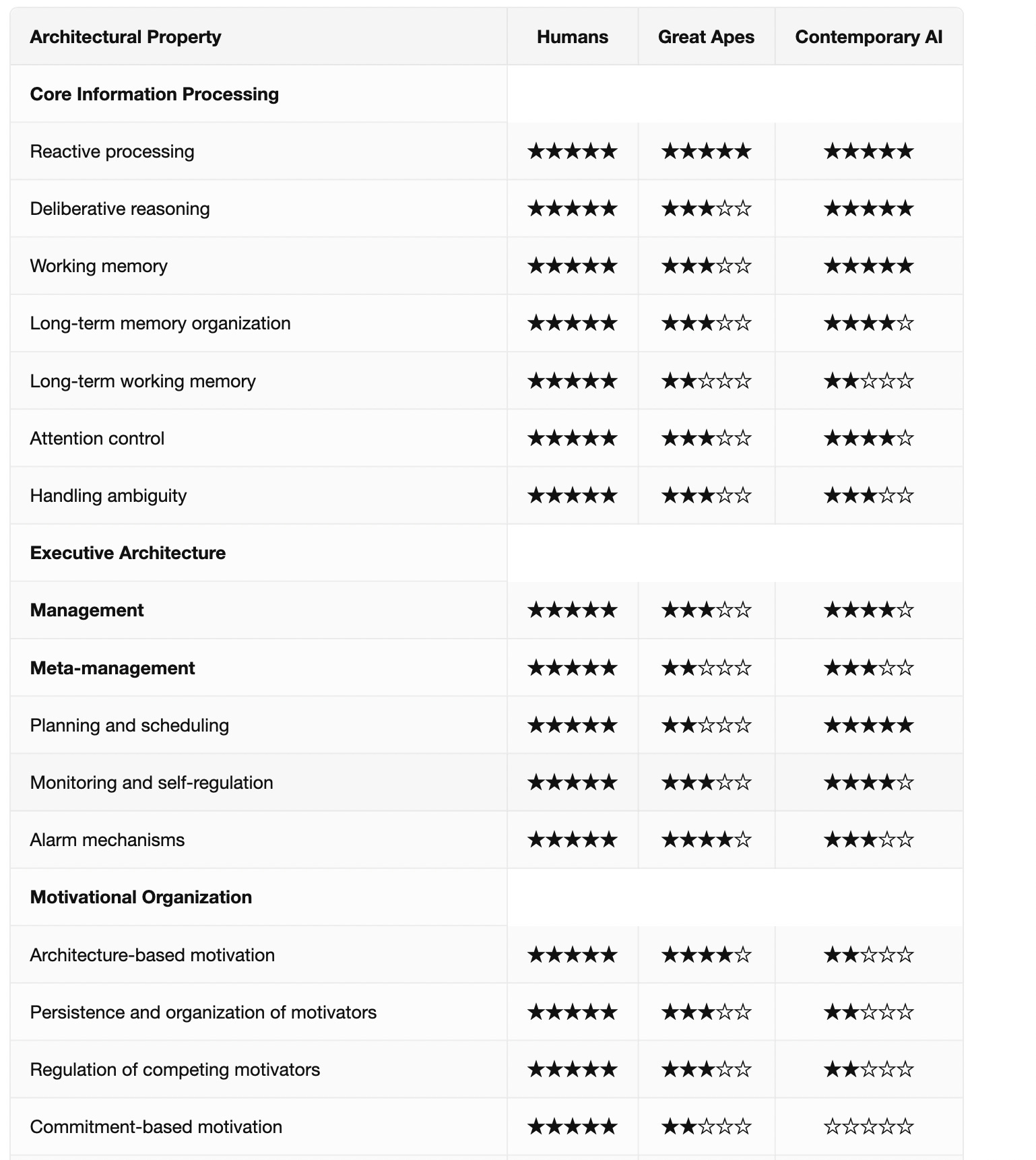
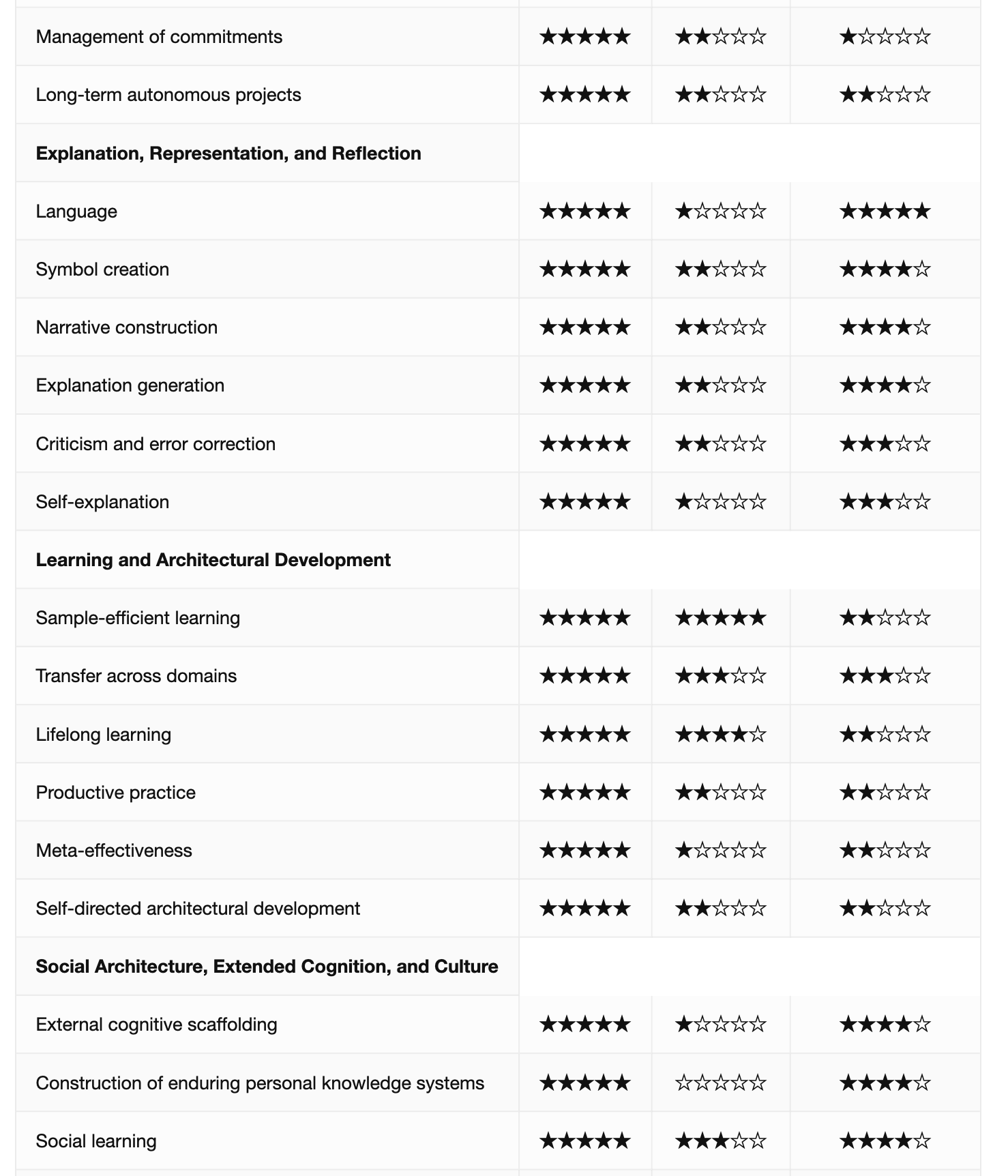

Note. The stars summarize qualitative judgments about the relative presence, breadth, degree of development, persistence, or integration of each architectural property. Different rows reflect different kinds of architectural comparison and should not be interpreted as measurements on a common quantitative scale. Nor do the stars represent an overall intelligence score. Five stars should not be interpreted as universally “better”: an architecture may be exceptionally effective for particular purposes while lacking properties that are highly developed in another system. The ratings for contemporary AI are especially provisional because AI architectures are changing rapidly and differ substantially across systems.
Several entries require clarification.
Working memory in humans is not equivalent to the context window of a language model. A context window makes information temporarily available for processing, but human working memory is embedded in perception, action, motivation, attention, long-term memory, and continuing agency. The comparison therefore identifies a functional resemblance without assuming architectural identity.
Long-term working memory is also distinct from ordinary long-term memory. The term refers to the capacity, especially characteristic of expertise, to use learned retrieval structures to gain rapid access to relevant information stored in long-term memory. A skilled reader, chess player, scientist, musician, or physician does not hold everything needed for a complex task in working memory at once. Instead, organized knowledge allows the person to retrieve what is needed as the task unfolds. Humans develop such systems through extensive experience and practice. Contemporary AI can retrieve information from parameters, databases, external tools, and retrieval systems, but it does not yet ordinarily develop a comparably integrated, personally organized long-term working memory through a continuous life of self-directed activity.
Narrative construction deserves separate treatment from language. Language permits the encoding and communication of information, whereas narrative organizes events, actions, agents, causes, goals, and consequences across time. Human narratives help structure autobiographical memory, identity, social understanding, planning, explanation, and the interpretation of discontinuities in experience. Contemporary AI can generate sophisticated narratives, but its narrative production is generally not grounded in an enduring autobiographical history, a persistent identity, or long-term projects of its own. Great apes may represent temporally extended social and practical sequences, but the evidence for human-like narrative organization remains limited.
The social rows likewise concern more than the frequency of interaction. Shared intentions, commitment-based motivation, relationship management, and participation in institutions require representations and control processes through which agents coordinate activities, preserve obligations, monitor trust and reputation, respond to norms, and organize action around projects that no individual could complete alone. Humans are distinctive not because other animals lack sociality, but because human social architectures support unusually extensive cooperation, division of labour, institutional participation, and cumulative cultural development. Contemporary AI can participate in socially organized activity through human-designed systems, but generally lacks the enduring, autonomous commitment structures and social-developmental continuity characteristic of human agents.
The table also distinguishes explanation generation from self-explanation. Contemporary AI can produce excellent explanations, criticize proposals, identify inconsistencies, and revise outputs. These abilities should not be dismissed merely because they often occur within prompted interactions. Yet humans can use explanation as part of a continuing process of changing their own understanding, standards, habits, projects, and methods. Self-explanation can therefore contribute to architectural development: it may reorganize knowledge, reveal gaps, generate new questions, and alter subsequent learning. Current AI exhibits parts of this process, but generally without the same persistence, autonomy, and developmental continuity.
The most consequential differences in Table 1 concern combinations of properties rather than isolated capacities. Humans integrate working memory, long-term working memory, narrative, explanation, management, meta-management, architecture-based motivation, productive practice, external cognitive scaffolding, and cumulative culture. These components can mutually amplify one another. Language supports explanation; explanation reorganizes memory; memory supports planning; planning organizes practice; practice changes capacities; meta-management evaluates those changes; and external tools preserve and extend the results. Human intelligence is therefore not adequately characterized by adding up separate abilities. Its distinctive character depends partly on the organization and recursive interaction of architectural properties.
This point is especially important for understanding learning. Great apes learn throughout their lives, and contemporary AI systems can acquire, adapt, and apply extensive information. Humans, however, can also deliberately organize conditions for their own learning. They construct curricula, seek criticism, design exercises, choose tools, form intellectual communities, revise workflows, record insights, and cultivate motivational dispositions. Through productive practice, they improve particular capabilities. Through meta-effectiveness, they attempt to improve the processes by which they learn, think, regulate themselves, and organize their cognitive environments. Human architectural development can thus become partly self-directed.
None of this establishes a permanent boundary between human and artificial intelligence. Artificial systems may increasingly acquire persistent memory, autonomous projects, self-monitoring, richer motivational organization, continual learning, narrative continuity, and capacities for modifying their own methods. The architectural conception is valuable precisely because it does not depend on declaring that AI either is or is not intelligent. It instead supplies a vocabulary for describing which architectural properties a system possesses, how strongly they are developed, how they interact, and how they change.
The comparison therefore reinforces the main claim of this paper. Humans, great apes, and contemporary AI do not merely occupy different positions on a single intelligence scale. Nor are they adequately described by profiles of separate abilities alone. They instantiate differently organized information-processing architectures. Their performances provide evidence about those architectures, but performance is not itself the final object of explanation. The deeper scientific task is to understand the mechanisms, representations, communication pathways, motivational systems, learning processes, and developmental possibilities that make different forms of intelligence possible.
6.7 Implications for the concept of intelligence
Viewed through this integrative design-oriented way it becomes especially clear why intelligence cannot be represented adequately as a single quantity or a fixed multidimensional profile. Two systems may display similar current performance while differing in the mechanisms through which their performance was acquired, in what they can learn next, and in whether they can deliberately improve their own learning and control processes.
An architectural conception therefore asks more than how well an agent performs. It asks what kinds of transformation the architecture permits, what governs those transformations, and how changes to one component alter the operation of the system as a whole.
Human-like intelligence includes capacities to acquire knowledge and skills, but also capacities to construct explanations, expose representations to criticism, detect and correct errors, reorganize motivation, develop better forms of management and meta-management, and use productive practice to influence one’s further development. These capacities support recursive architectural development: changes in the architecture can improve the processes through which later changes are produced. Intelligence is thus not merely manifested in successful performance. It is also manifested in the architecture’s ability—and in the agent’s disposition—to become differently and more effectively organized.
7. Intelligence Reconsidered
7.1 Intelligence as an Architectural Property
This paper began by questioning one of the most common questions in discussions of artificial intelligence: Is AI intelligent? I argued that the question is deceptively simple because it presupposes that intelligence is fundamentally a binary property. Once we reject that assumption, the discussion naturally progresses through scalar and multidimensional conceptions before arriving at a more explanatory alternative.
The central claim advanced here is that intelligence is best understood as a property of information-processing architectures. Binary classifications, scalar measures, and multidimensional profiles each capture important aspects of intelligent behaviour, but none fully explains what intelligence is. They describe patterns of performance. The architectural conception instead seeks to explain those performances by identifying the mechanisms, representations, communication pathways, motivational systems, learning processes, and developmental capacities that produce them.
This perspective also clarifies why intelligent systems can differ in ways that are not adequately captured by a single dimension or even by a collection of independent dimensions. Two systems may perform similarly on one task while relying upon fundamentally different architectures. Conversely, systems with similar architectural organizations may exhibit different performances because of differences in experience, knowledge, motivation, or opportunity. The principal object of scientific explanation therefore becomes not intelligent performance itself but the information-processing architectures that generate, regulate, and develop that performance. Behaviour provides evidence; architecture provides the explanation.
Donald’s work reminds us that the architecture of intelligence extends beyond the nervous system itself. Human intelligence develops through continuous interaction with symbolic cultures and external knowledge systems, making mature cognition simultaneously biological, technological, and social. (See Donald (2004) The definition of human nature. Chapter 2 of The New Brain Sciences)
7.2 Implications for Research and Assessment
Recasting intelligence as an architectural property does not diminish the value of psychometrics, comparative psychology, neuroscience, or AI benchmarking. On the contrary, these disciplines become even more important because they provide diverse sources of evidence from which architectural properties can be inferred. Tests of reasoning, memory, learning, creativity, language, executive function, and other capacities remain indispensable. Their interpretation, however, shifts. Rather than treating scores or benchmark performances as reflecting intelligence itself, they become observations that help reveal the underlying organization of an intelligent system.
This perspective also encourages richer comparisons among humans, other animals, and artificial systems. Instead of asking which system is “more intelligent,” we can ask which architectural properties they share, which they lack, how those properties interact, and how they change through learning and development. Such comparisons acknowledge both continuity and difference without forcing every form of intelligence onto a single quantitative scale.
An architectural conception also broadens the scope of research. It encourages investigations into how mechanisms cooperate, how motivational systems influence cognition, how learning reorganizes architecture, how social commitments and institutions become represented and regulated, how external cognitive resources become integrated into intelligent activity, and how new architectural capabilities emerge through development. These questions are central not only to psychology and neuroscience but also to education, comparative cognition, psychometrics, social science, and artificial intelligence.
Human intelligence is not adequately understood as the property of an isolated biological individual. Human architectures are socially embedded. They develop through attachment, imitation, language, teaching, shared intentions, norms, commitments, institutions, and participation in cumulative culture. They are also coupled to external symbol systems and to Popper’s World 3: the objective products of thought that humans create together and that subsequently reshape what individuals and communities can know and do. Human social agency is therefore not an optional application of intelligence. It is part of the architectural organization through which distinctively human intelligence develops and operates.
7.3 Developing Intelligence
Viewing intelligence as an architectural property also changes how we think about improving it. If intelligence resides fundamentally in information-processing architectures, then developing intelligence consists not merely in acquiring additional knowledge or improving performance on particular tasks, but in improving the architecture itself. Productive practice, explanation, criticism, error correction, reflective self-regulation, architecture-based motivation, meta-effectiveness, and the deliberate design of external cognitive environments all become means of architectural development.
Such development is simultaneously individual, social, and technological. People improve through interaction with teachers, collaborators, critics, institutions, books, diagrams, software, AI systems, and other products of World 3. These resources can become functionally integrated with memory, management, meta-management, motivation, and productive practice. Recursive architectural development therefore need not occur wholly inside the skull: humans can improve the systems of knowledge, relationships, practices, and tools through which they subsequently think and act. From this perspective, intelligence is not simply something one possesses; it is also something one can cultivate, scaffold, and collectively extend.
7.4 Final Reflections
The question posed by this paper was not simply whether artificial intelligence is intelligent, but what intelligence itself is. The answer proposed here is neither binary, scalar, nor merely multidimensional. Intelligence is more fundamentally a property of information-processing architectures.
This architectural conception does not replace earlier conceptions of intelligence; it explains them. Binary classifications, scalar measures, and multidimensional profiles remain valuable because they summarize important aspects of intelligent performance. Yet performance is not intelligence itself. Rather, performance provides evidence from which we infer the properties of the architectures that produce it.
Viewing intelligence through an architectural lens shifts attention from measuring intelligent behaviour to understanding the mechanisms, organization, communication pathways, motivational systems, learning processes, and developmental capacities that make such behaviour possible. Behaviour provides evidence; architecture provides the explanation. This perspective provides a richer framework for comparing humans, other animals, and artificial systems while opening new directions for research in psychology, education, neuroscience, comparative cognition, psychometrics, and artificial intelligence.
The principal contribution of this paper is not simply to propose another definition of intelligence or another framework for classifying intelligent behaviour. Rather, it proposes an explanatory framework in which intelligence is understood as a property of information-processing architectures. From this perspective, behavioural performance provides evidence about intelligence, but the primary scientific task is to explain intelligent behaviour by identifying and understanding the mechanisms, organizations, and interactions that constitute intelligent architectures.
If intelligence is not binary, neither is it merely scalar or multidimensional. More fundamentally, intelligence is a property of information-processing architectures.
Colophon
Unlike my previous articles, this paper was not produced by writing a complete first draft and then asking ChatGPT to edit it. It emerged through an extended process of back-and-forth development in which I supplied the central arguments, theoretical commitments, bibliographical references, distinctions, sources, corrections, and judgments, while ChatGPT helped me explore alternative formulations, organize the material, expose gaps, and generate successive drafts. Compare my article on epistemic agency.
Future
I will likely turn this and the preceding article on AI+intelligence into an ebook on Leanpub. I hope to get feedback on the article which will inform the book.