Beyond “Is AI Intelligent?”: Intelligence as Architecture
How to compare the intelligence of humans, other animals, and AI

Abstract
Debates about artificial intelligence often ask whether AI is—or is not—intelligent. Other approaches treat intelligence as a single quantity or as a profile of several measures of abilities. Each approach can be useful, but none adequately explains how intelligent behaviour is produced. None of them sufficiently captures what it means to be intelligent.
This article presents a fourth conception: intelligence as a property of information-processing architectures. Intelligent behaviour arises from organized systems of mechanisms, representations, memories, motivational processes, communication pathways, and layers of control. These architectural properties include reactive and deliberative processing, management and meta-management, working memory, long-term working memory, alarms, self-reminding, learning, explanation, social information processing, and the integration of external cognitive resources.
This article is a condensed synthesis of two longer essays: “Why You Can’t Say AI Is—or Is Not—Intelligent” and “If Intelligence Isn’t Binary, What Is It?”. Readers who want the fuller argument, its intellectual history, additional examples, and a more detailed comparison of humans, other animals, and AI should consult those articles.
Contents
The binary conception
The scalar conception
The multidimensional conception
The architectural conception
From abilities to architectures
The architecture of human-like intelligence
Learning as architectural change
Humans, other animals, and contemporary AI
Intelligence reconsidered
From intelligence to consciousness
Introduction
Debates about artificial intelligence often revolve around a deceptively simple question:
Is AI intelligent?
Some people answer yes, pointing to the ability of contemporary AI systems to write, reason, translate, program, explain difficult ideas, and solve problems that once seemed to require human intelligence. Others answer no, arguing that these systems merely manipulate patterns, predict tokens, or simulate capacities they do not genuinely possess.
The disagreement partly reflects different assumptions about what intelligence is. Some people treat intelligence as something a system either possesses or lacks. Others treat it as a quantity: a person, animal, or machine can be more or less intelligent. Still others regard intelligence as a collection of capacities, such as language, planning, memory, creativity, social understanding, and learning.
Each of these conceptions captures something useful. None, however, provides a sufficiently deep explanation of intelligent behaviour.
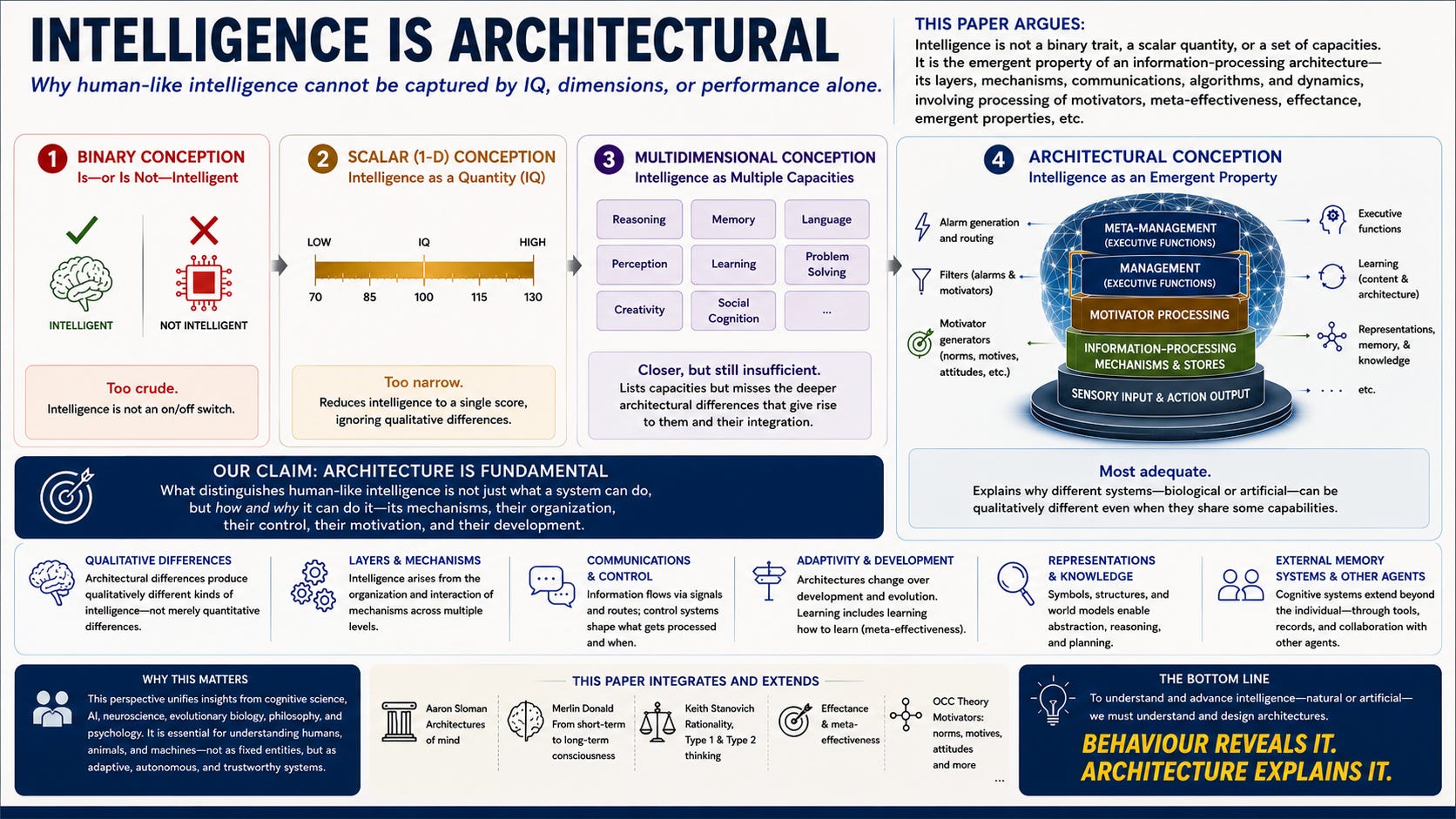
This article proposes a fourth conception. Intelligence is more fundamentally a property of information-processing architectures: organized systems of mechanisms, representations, memories, communication pathways, evaluative processes, and layers of control. Intelligent behaviour arises not from a single faculty, nor merely from a collection of abilities, but from the organization and interaction of these architectural components.
From this perspective, the most illuminating question is not simply whether a system is intelligent. It is:
What kind of information-processing architecture does the system possess, and how does that architecture produce, regulate, and develop intelligent behaviour?
This approach does not require us to abandon IQ tests, benchmarks, multidimensional profiles, or practical classifications. Rather, it places them within a broader explanatory framework. Performance provides evidence about intelligence; architecture helps explain that performance.
A common definition of intelligence
Here’s a definition of human intelligence which can be measured, taken from Wikipedia:
Human intelligence is the intellectual capability of humans, which is marked by complex cognitive feats and high levels of motivation and self-awareness. Using their intelligence, humans are able to learn, form concepts, understand, and apply logic and reason. Human intelligence is also thought to encompass their capacities to recognize patterns, plan, innovate, solve problems, make decisions, retain information, and use language to communicate.
Now let’s look at four conceptions of intelligence which more or less fit this mold.
Four ways of thinking about intelligence
1. The binary conception
The binary conception treats intelligence as an all-or-none property. A creature or system either is intelligent or it is not.
Binary judgments can be useful when a practical decision requires a threshold. We may need to decide whether a person has sufficient cognitive capacity to give informed consent, whether someone can drive safely, or whether a robot can navigate independently in a specified environment.
But binary classifications suppress enormous differences among the systems placed on either side of the threshold. Calling both a crow and a human intelligent tells us little about the very different ways their minds are organized. Saying that a calculator is not intelligent tells us little about its remarkable competence in symbolic arithmetic. Saying that LLM-based AI is or is not intelligent tells us little about how it really compares to human intelligence.
A binary judgment may tell us whether a system meets a chosen criterion. It does not provide a satisfactory general theory of intelligence.
2. The scalar conception
The scalar conception replaces the yes-or-no question with a quantitative one:
How intelligent is this person or system?
Psychometric intelligence research made this question empirically tractable. Standardized tests allow performances to be compared with those of other people, and overall scores can summarize evidence from several cognitive tasks.
Psychometric work on IQ is scientifically important. IQ is neither a meaningless number nor simply an obsolete attempt to rank people. Intelligence testing is one of psychology’s most extensively developed measurement traditions, and intelligence-test performance predicts outcomes that matter.
Nevertheless, a summary score necessarily compresses information. Two people with similar overall IQ scores may have different profiles of verbal comprehension, visual-spatial ability, fluid reasoning, working memory, and processing speed. Even people with similar profiles may employ different strategies, possess different knowledge, and respond differently to novelty, uncertainty, or distraction.
The limitations become still clearer when scalar measures are extended beyond the human populations for which they were designed. Assigning an IQ-like score to a crow, an octopus, a great ape, or a large language model may produce an arresting comparison, but the number can conceal profound differences in what these systems can do and how their abilities are produced.
A scale may compare performance on a defined set of tasks without showing that the systems possess intelligence of the same kind.
3. The multidimensional conception
The multidimensional conception asks:
In what respects is this person or system intelligent?
Instead of representing intelligence with one number, it describes a profile of quantitative measures of capacities. These might include language, memory, planning, spatial reasoning, creativity, learning, social understanding, metacognition, and sample efficiency.
This is a substantial improvement when comparing very different kinds of systems. A crow may excel at tool use and causal reasoning while lacking human language. An octopus may possess extraordinary sensorimotor adaptability through an organization of control radically different from that of vertebrates. A large language model may produce fluent explanations and write software while lacking continuous bodily perception, autonomous motivation, and an enduring personal history.
It would be misleading simply to declare one of these systems more intelligent than another. A multidimensional profile preserves important differences that a single score compresses.
Yet multidimensional approaches usually remain descriptions of how much of each measured ability a system displays. Two systems may obtain similar planning scores while relying on entirely different processes. One may explicitly represent alternative futures, evaluate them against competing concerns, schedule intermediate actions, and revise its plan when circumstances change. Another may generate an equally successful answer by exploiting learned statistical regularities.
At the level of observable performance, the systems may look similar. At the level of underlying organization, they may be radically different.
4. The architectural conception
The architectural conception changes the main questions:
What information-processing architecture gives rise to the system’s intelligent behaviour? How do two agents or classes of agents differ in their underlying autonomous agency?
An information-processing architecture is not simply a list of abilities. It is the organized arrangement of mechanisms through which a system perceives, remembers, evaluates, learns, reasons, plans, acts, and regulates itself over time.
Architectures can differ in at least four broad ways:
They may contain different layers of processing, including reactive, deliberative, managerial, and meta-managerial processes.
They may possess different mechanisms within those layers, including attention control, working memory, planning, scheduling, conflict resolution, self-reminding, strategy selection, and ambiguity detection.
They may differ in their communication pathways. An alarm signal might influence only immediate action, interrupt or otherwise influence ongoing executive processes, or reach meta-management and initiate a broader reassessment.
They may use different representations and algorithms even when they accomplish similar tasks. They may depend on symbolic structures, vector representations, production rules, neural networks, episodic simulations, narratives, other mechanisms, or combinations of these.
Some architectural differences are quantitative. Two systems with working memory may differ in capacity, duration, precision, or reliability. Two planning systems may differ in how many alternatives they can represent or how far ahead they can search.
Other differences are qualitative. An architecture that can schedule deliberation possesses a mechanism that is absent from a system that deliberates only when externally prompted. A system with meta-management does not merely have more reflection than one without it; it possesses an additional level of organization through which some of its own management processes can be evaluated and redirected.
The introduction of a new mechanism, layer, representation, or communication pathway may make entirely new forms of intelligent activity possible. These changes create genuine discontinuities in the space of possible minds. The differences among humans, various animals, and artificial systems are therefore not always differences of degree. They may be differences in kind, arising from the presence, absence, or organization of architectural mechanisms. I explore the broader significance of such qualitative transitions in Discontinuities: Love, Art, Mind.
Table 1. Comparing the four conceptions
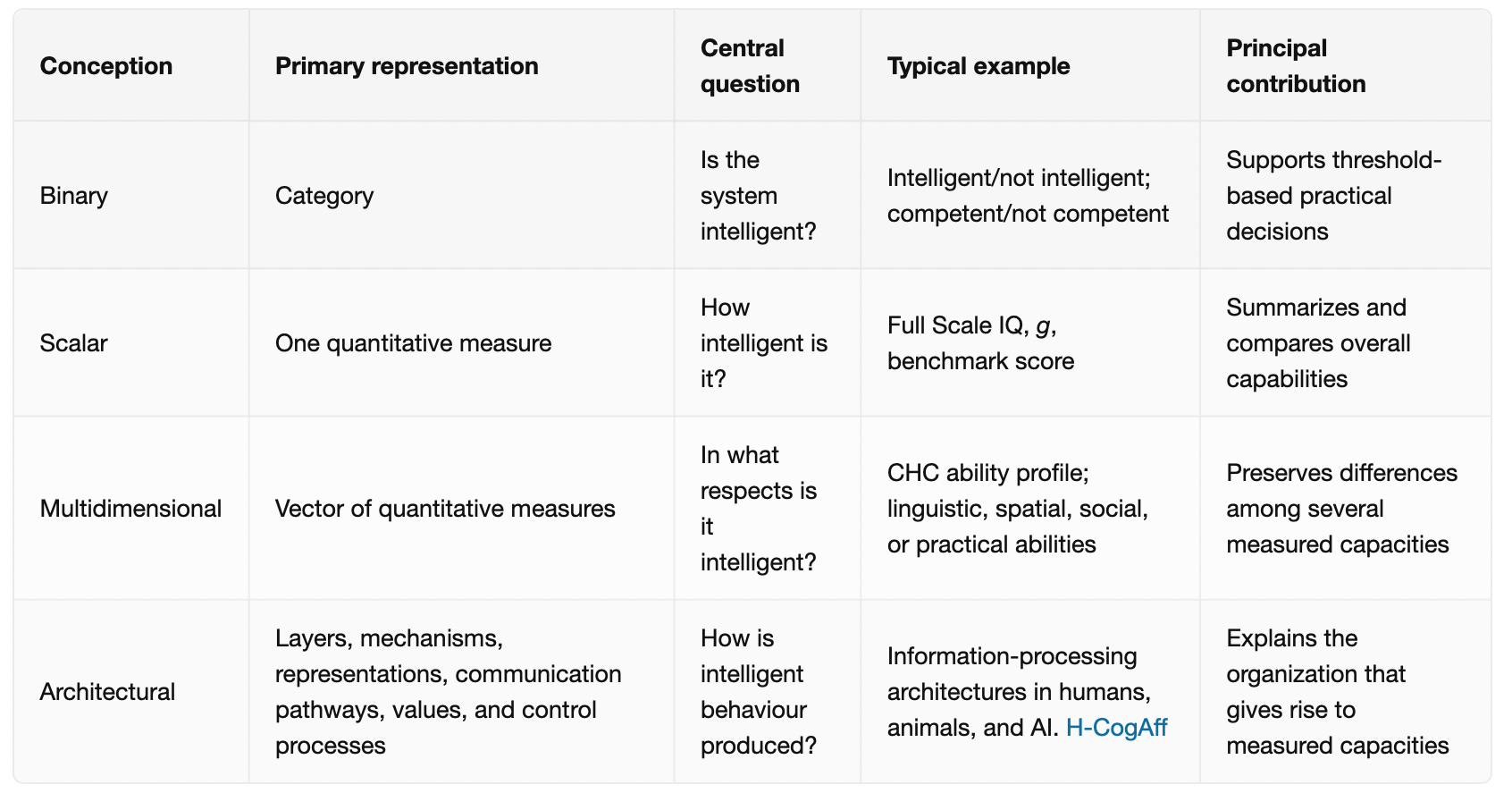
The four conceptions are not mutually exclusive. Binary classifications support practical decisions. Scalar measures summarize performance. Multidimensional profiles reveal relative strengths and weaknesses. An architectural account can incorporate all three while asking a deeper question: what underlying organization produces the classifications, scores, and profiles?
5. From abilities to architectures
The architectural approach belongs to an established tradition in artificial intelligence and cognitive science. Aaron Slomanargued that these disciplines should investigate the space of possible minds: the vast range of information-processing architectures that could exist in animals, humans, machines, and systems unlike anything yet encountered.
This perspective shifts attention away from searching for a single defining property of intelligence. Different minds may contain different mechanisms, organize them into different layers, use different representations, and connect their components in different ways.
The same architecture can also operate differently from moment to moment. In an emergency, an alarm may interrupt ongoing thought, redirect attention, increase the priority of an urgent concern, and initiate rapid action. While writing an essay, the same person may recruit semantic and episodic memory, analogy, planning, ambiguity detection, narrative construction, and extended deliberation. During rumination, persistent motivators, narrowed attention, repeated retrieval, and failures of disengagement may dominate.
The broad architecture remains relatively stable, but the configuration of mechanisms currently engaged changes.
This dynamic organization is one reason familiar divisions such as Daniel Kahneman’s distinction between fast and slow thinking, although valuable, are insufficient as general accounts of intelligence. Human information processing involves more than two systems. It includes many mechanisms operating at different levels, interacting through complex pathways, and becoming active in different combinations.
An architectural account also encourages an integrative, design-oriented approach. Rather than studying memory, reasoning, motivation, affect, and executive control as if they belonged to independent systems, this approach asks how all of them must operate together within a complete autonomous agent.
By autonomous agency, I mean the capacity of a system to generate, evaluate, prioritize, pursue, suspend, revise, and abandon its own motivators while responding adaptively to changes in its environment and internal state, given limited resources (time, working memory capacity, other agents, etc.).
Explaining such agency requires more than explaining cognition narrowly understood. It requires understanding how perception, motivation, memory, learning, affect, deliberation, management, and action are coordinated over time.
[Insert Figure: Human-like Autonomous Agency Architecture]
6. The architecture of human-like intelligence
No definitive architecture of human-like intelligence yet exists. Nevertheless, we can identify several broad classes of mechanisms that a satisfactory account will need to explain.
6.1 Reactive processing, management, and meta-management
Reactive mechanisms connect situations relatively directly with responses. They allow a system to recognize familiar conditions and respond rapidly without constructing and comparing elaborate alternatives. This includes motive generators that operate asynchronously to executive processes (management and meta-management).
Management processes perform deliberative activities. The can evaluate motivators and situations and make decisions about whether, when and how to act. Deliberative processing supports the representation of possibilities. It allows an agent to consider actions that have not yet occurred, predict consequences, compare alternatives, and construct plans.
Meta-management adds another level. It includes but goes beyond what is sometimes called reflective processing. It allows some management processes themselves to become objects of evaluation. A person may notice not only that a problem remains unsolved, but that they are approaching it unproductively. They may recognize that they are fixated on one representation, avoiding an uncomfortable possibility, repeatedly checking the same evidence, or terminating inquiry too quickly.
Management and meta-management overlap with what psychologists often call executive functions. But executive functioning should not be treated as one more dimension beside memory or language. It refers to mechanisms that help organize and regulate the use of many other capacities.
6.2 Motivation, evaluation, and control
Intelligent agents do not merely process information; they must determine what matters.
Human motivation is not adequately described by goals alone. People are influenced by projects they want to complete, norms they believe should be respected, and preferences—also known as attitudes—concerning what they like or dislike. Motives are goals that have intensity (behavioral propensity) and insistence (attentional propensity), and valence. There are different states of motives: wishes, wants and intentions. Motivators compete for attention, planning, and action.
Architectural mechanisms must evaluate motivators according to such properties as importance, urgency, opportunity, cost, and compatibility with other commitments. Motivators don’t merely differ in “expected utility”, which is a quantitative measure, but in many qualitative ways. Some become sufficiently insistent to interrupt or otherwise influence ongoing executive processes. Others are deferred, suppressed, forgotten, or abandoned. Hence human-like information processing architecture contains filters and suppressors of motivators.
Human-like autonomous agency depends partly on how these processes are governed. A highly capable person may reason poorly if attention is repeatedly captured by irrelevant concerns, if important motivators fail to become insistent, or if short-term impulses continually displace long-term projects.
Intelligence concerns what an architecture is capable of doing. Rationality also concerns whether, when, and why those capacities are appropriately deployed. See What intelligence tests miss: The psychology of rational thought.
6.3 Alarms, attention, and interruption
Alarm mechanisms are a particularly important architectural class. They detect situations requiring rapid reassessment and can redirect processing before slower deliberation has run its course.
Architectures may differ in where alarm signals travel. An alarm might trigger an immediate reaction, influence management, or reach meta-management and cause an agent to reconsider a broader pattern of activity.
Alarms are not themselves emotions. Fear, anxiety, anger, grief, and other affective phenomena may emerge from interactions among alarm mechanisms, motivator processing, attention, memory, bodily changes, management, and action.
Mental perturbance, for example, can occur when insistent motivators repeatedly capture attention and disrupt other activities. The perturbance is an emergent condition of the architecture, not a mechanism located in one dedicated emotional module.
6.4 Memory, self-reminding, and governance across time
Human-like agency requires more than the storage of information. It depends on bringing the right information to mind at the right time.
Working memory makes some information temporarily available for current processing. Long-term memory preserves semantic knowledge, experiences, procedures, and associations. Long-term working memory, a concept developed by K. Anders Ericsson and Walter Kintsch, allows experts to use learned retrieval structures to gain rapid access to information stored in long-term memory while a task unfolds. It’s long-term memory retrieval from which approaches the speed of retrieval from working memory.
A chess master, scientist, musician, physician, or experienced writer does not maintain everything relevant to a complex activity in working memory simultaneously. Instead, organized knowledge and retrieval cues allow relevant information to become available as it is needed. Long-term working memory is therefore not simply a larger working-memory container. It is a learned architecture of access.
Self-reminding is also essential. An autonomous agent must recover deferred intentions, notice emerging opportunities, remember commitments, and resume interrupted projects. A person who forms excellent plans but never retrieves them when they become relevant will not behave intelligently over extended periods.
These mechanisms help connect the present to the future. They allow people to govern activity not only from moment to moment but across days, years, and sometimes an entire life.
In A Mind So Rare: The Evolution of Human Consciousness, Merlin Donald distinguishes levels of conscious integration. Immediate sensory awareness and short-term control are supplemented in humans by forms of intermediate- and long-term consciousness. These allow intentions, narratives, commitments, and projects to organize behaviour across periods far exceeding the duration of immediate awareness.
Intermediate- and long-term consciousness depend on long-term memory, long-term working memory, prospective memory, self-reminding, contextual retrieval, and external symbolic resources. An intention formed today may need to influence activity tomorrow, next year, or decades later. Human-like autonomous agency depends on bridging the discontinuities that occur whenever attention moves elsewhere or consciousness is interrupted.
A language model’s context window bears a limited functional resemblance to working memory, but the two should not be identified. Human working memory is embedded in continuing perception, action, motivation, autobiographical memory, and self-directed agency.
Human intelligence thus involves different forms of memory and different time-spans of consciousness.
6.5 Social and cultural architecture
Human intelligence is not merely the intelligence of an isolated biological organism.
Humans represent relationships, obligations, commitments, reputations, norms, institutions, and shared projects. These representations support cooperation, division of labour, shared intentions, teaching, cumulative culture, and organizations that continue beyond the lives of their individual members.
Social signalling is an important part of this architecture. Much human behaviour communicates information about competence, trustworthiness, loyalty, status, identity, intentions, and group membership. Kevin Simler and Robin Hanson’s The Elephant in the Brain emphasizes that many activities have hidden social functions, including signalling desirable characteristics to others. Will Storr’s The Status Game examines the pervasive role of status seeking, recognition, and social comparison in human life.
Whether or not one accepts every evolutionary claim in these books, both highlight the extensive information-processing requirements of social life. Human agents must represent reputations, alliances, obligations, trust, competence, social expectations, and relative status. They must also interpret the signals transmitted by others and regulate the signals they themselves produce.
A major resource of human motivation is commitments. Michel Aubé argued that commitments—to people, groups, organizations, institutions, and projects—constitute a distinctive class of motivational resource. Commitments become objects of perception, evaluation, planning, protection, and emotional regulation. His account is developed in “A Commitment Theory of Emotions” and “Beyond Needs: Emotions and the Commitments Requirement.”. See also my blog post on On The Relationship-building Proclivities of Human Nature.
This helps explain why threats to relationships, obligations, identities, and institutions can become so motivationally insistent. Human agents do not merely pursue individual rewards or satisfy biological needs. They organize much of their lives around commitments that persist across circumstances and coordinate their behaviour with that of others. Similarly, the prospect of securing and protecting commitments can generate strong motivation.
Human beings are also immersed in external symbolic systems: language, writing, mathematics, diagrams, books, laws, scientific theories, digital tools, and cultural practices. As Merlin Donald emphasized, mature human cognition develops within such symbolic cultures.
External resources do not merely store information that an otherwise complete mind occasionally consults. They become functionally integrated with memory, attention, planning, and management. A notebook can preserve an intention. A diagram can reorganize a problem. A calendar can implement prospective memory. A search system can extend retrieval. An AI system can support explanation, criticism, and the exploration of alternatives. Human minds are extended into their environments.
Human intelligence is therefore simultaneously biological, social, cultural, and technological.
7. Learning as architectural change
Intelligence is often defined partly as an ability to learn. But saying that a system learns does not tell us what changes, which mechanisms produce the change, or whether the system can influence its own development.
From an architectural perspective, learning is not one process that transfers information into long-term memory. It is a heterogeneous family of processes capable of modifying many parts of an architecture.
Learning may change factual knowledge, concepts, procedures, habits, attentional dispositions, retrieval pathways, motivational priorities, evaluative standards, or management strategies. It may establish new connections between mechanisms or alter when existing processes are recruited.
A central difference among systems concerns sample efficiency: how much experience they require to acquire a useful capability. Humans sometimes learn from remarkably few examples because new information can be interpreted through extensive prior knowledge, causal understanding, language, analogy, social instruction, and existing conceptual structures.
The enormous difference between the amount of data used to train contemporary AI and the amount from which individual humans learn has been described as “the sample-efficiency black hole”. Although the comparison must be made carefully, it points to a major architectural question: why can humans sometimes extract durable, transferable understanding from so little direct experience? Human learning is often rapid and transcends data. (E.g., Kindergarten children’s sensitivity to geometry in maps:
Children spontaneously extracted and used relationships of both distance and angle in the maps, without prior demonstration, instruction, or feedback, but they failed to use the sense information that distinguishes an array from its mirror image.
Contemporary AI systems often require enormous training datasets, although their trained representations may then support rapid adaptation and impressive generalization. “Learning” therefore names very different architectural processes in humans and machines.
The most consequential learning is sometimes recursive. An agent may improve not only what it knows, but how it learns, practises, retrieves information, manages attention, evaluates evidence, and corrects errors.
7.1 Productive practice
Productive practice requires activities that target appropriate components of a developing capability, generate informative feedback, and produce changes that transfer beyond the practised instance.
Practice does not improve performance merely through repetition. A person can repeat ineffective methods, automate errors, or become highly skilled at a narrowly practised task without acquiring a more general capability.
A person can also learn to design better practice. They may become more skilled at diagnosing weaknesses, choosing exercises, arranging feedback, spacing learning, retrieving knowledge, and modifying their environment.
The object of learning can therefore be another learning or management process. Through productive practice, architectural development can become partly self-directed.
7.2 Explanation, criticism, and error correction
One especially important form of human learning involves constructing and improving explanations.
An explanation does more than summarize observations or reproduce a pattern. It proposes an account of why something happens, how a mechanism operates, or what underlying structure produces an observed regularity.
Good explanations support transfer because they help distinguish relevant from irrelevant variation. They allow an agent to reason about new cases, anticipate consequences, and intervene more intelligently.
Explanation construction recruits many mechanisms: prior knowledge, analogy, causal representation, working memory, long-term memory, imagination, language, and narrative. Management processes may formulate questions, retrieve information, compare candidate accounts, and determine whether an explanation is adequate for the current purpose. Meta-management may detect that the problem has been framed poorly or that an attractive answer is being accepted too quickly.
As Karl Popper pointed out, explanations improve through criticism. Criticism involves searching for inconsistency, conflicting evidence, hidden assumptions, counterexamples, explanatory gaps, and more successful alternatives. It depends not only on logical competence but on motivation: an inconsistency produces no intellectual progress unless it is noticed and treated as important.
Error detection is not identical to error correction. A system may receive feedback that an answer is wrong without possessing the representations needed to diagnose the failure. Correction may require revising a belief, replacing an explanatory model, restructuring a representation, abandoning a goal, changing a practice method, or altering the standards by which future proposals are evaluated.
These activities form a recursive cycle:
Experience and problems → explanatory conjectures → criticism → detection and correction of error → architectural change → improved capacity for further explanation and criticism.
The cycle does not merely add information to memory. It can change what the architecture subsequently notices, retrieves, questions, explains, and corrects.
Predictions and observations are indispensable within this process, but they should not be treated as the ultimate products of intelligence. Their deepest epistemic value often lies in how they contribute to the creation, criticism, and improvement of explanations.
7.3 Meta-effectiveness
I use the term meta-effectiveness for the capacity and disposition to become increasingly effective. Meta-effectiveness includes learning how to learn, but it is broader. An agent may improve how it allocates attention, retrieves and applies knowledge, manages projects, regulates interruptions, evaluates priorities, constructs explanations, detects errors, uses external resources, or modifies its own habits.
Meta-effectiveness is not a separate faculty. It emerges from the interaction of management, meta-management, self-reminding, motivation, learning, productive practice, and long-term governance.
Two agents may possess similar current abilities but very different developmental potential. One may diagnose its limitations, seek criticism, organize productive practice, and improve the mechanisms underlying later performance. Another may perform equally well in familiar situations but lack the capacity to reorganize itself when conditions change.
An architectural theory must therefore ask not only what a system can currently do, but what it can learn to do, which parts of it are modifiable, and whether it can participate deliberately in its own development.
Intelligence is partly a property of current organization and partly a property of architectural plasticity—and of how that plasticity is governed.
8. Humans, other animals, and contemporary AI
The architectural conception provides a better way to compare humans, other animals, and artificial systems.
Instead of asking which is most intelligent, we can ask:
Which mechanisms are present?
How are they organized and connected?
What representations do they employ?
How are motivators generated and regulated?
How does learning change the system?
Can it participate in directing its own development?
How is it integrated with social and external cognitive systems?
And several other questions.
Contemporary AI exceeds humans in numerous tasks, including calculation, search, pattern recognition, linguistic production, and the manipulation of large quantities of information. Great apes possess perceptual, practical, social, and motivational abilities that differ substantially from both human cognition and present AI.
Humans are distinctive not because they perform best at every task, but because they integrate a particular collection of architectural properties: language, autobiographical and semantic memory, narrative, planning, management, meta-management, architecture-based motivation, social commitments, productive practice, external cognitive scaffolding, cumulative culture, and sample-efficient learning and lifelong development.
The most consequential differences concern combinations of properties rather than isolated abilities.
Language supports explanation. Explanation reorganizes memory. Memory supports planning. Planning organizes practice. Practice changes capabilities. Meta-management evaluates those changes. External tools preserve and extend the results. Social institutions distribute criticism and knowledge across individuals and generations.
Human intelligence cannot be understood by simply adding up separate abilities. Its distinctive character depends partly on the organization and recursive interaction of architectural properties.
Contemporary AI can generate sophisticated explanations, criticize proposals, identify inconsistencies, and revise its outputs. These capacities should not be dismissed merely because they often occur within prompted interactions.
The architectural differences concern persistence, integration, autonomy, motivation, and developmental continuity. Humans can use explanation within enduring projects of education, inquiry, identity formation, professional development, and self-regulation. Explanations may alter not only an immediate answer but a person’s lasting knowledge, habits, standards, commitments, and methods.
Similarly, AI can produce narratives, but its narratives are generally not grounded in an enduring autobiographical history, persistent identity, and long-term projects of its own. AI systems may retrieve information through context windows, model parameters, databases, and external tools, but they do not ordinarily develop personally organized long-term working memory through a continuous life of self-directed activity.
These are not permanent boundaries. Artificial systems may increasingly acquire persistent memory, autonomous projects, continual learning, richer motivational organization, self-monitoring, narrative continuity, and the capacity to modify their own methods.
The architectural conception does not depend on declaring that AI either is or is not intelligent. It gives us a vocabulary for describing which properties a system possesses, how they are organized, how strongly they are developed, and how they change.
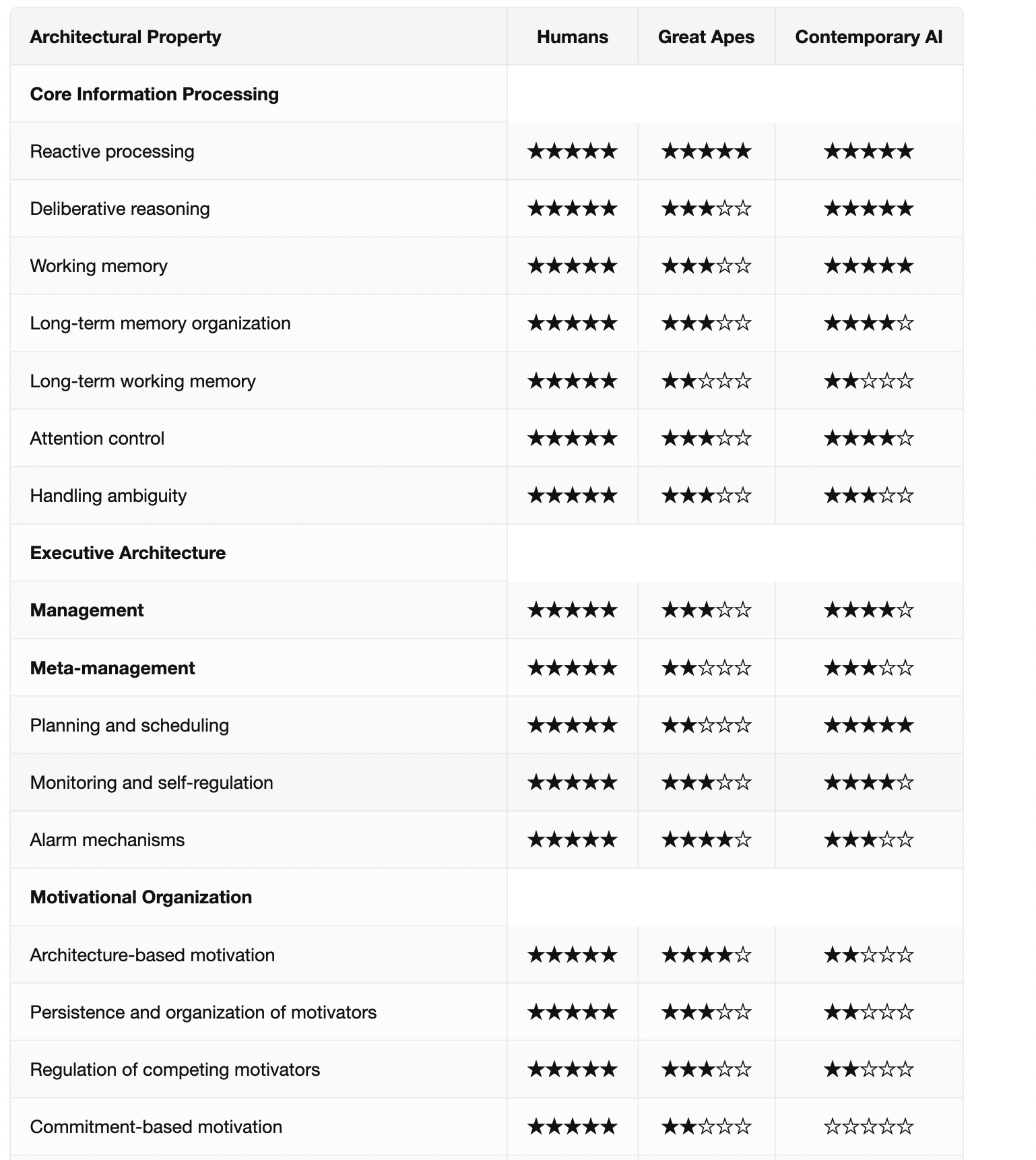
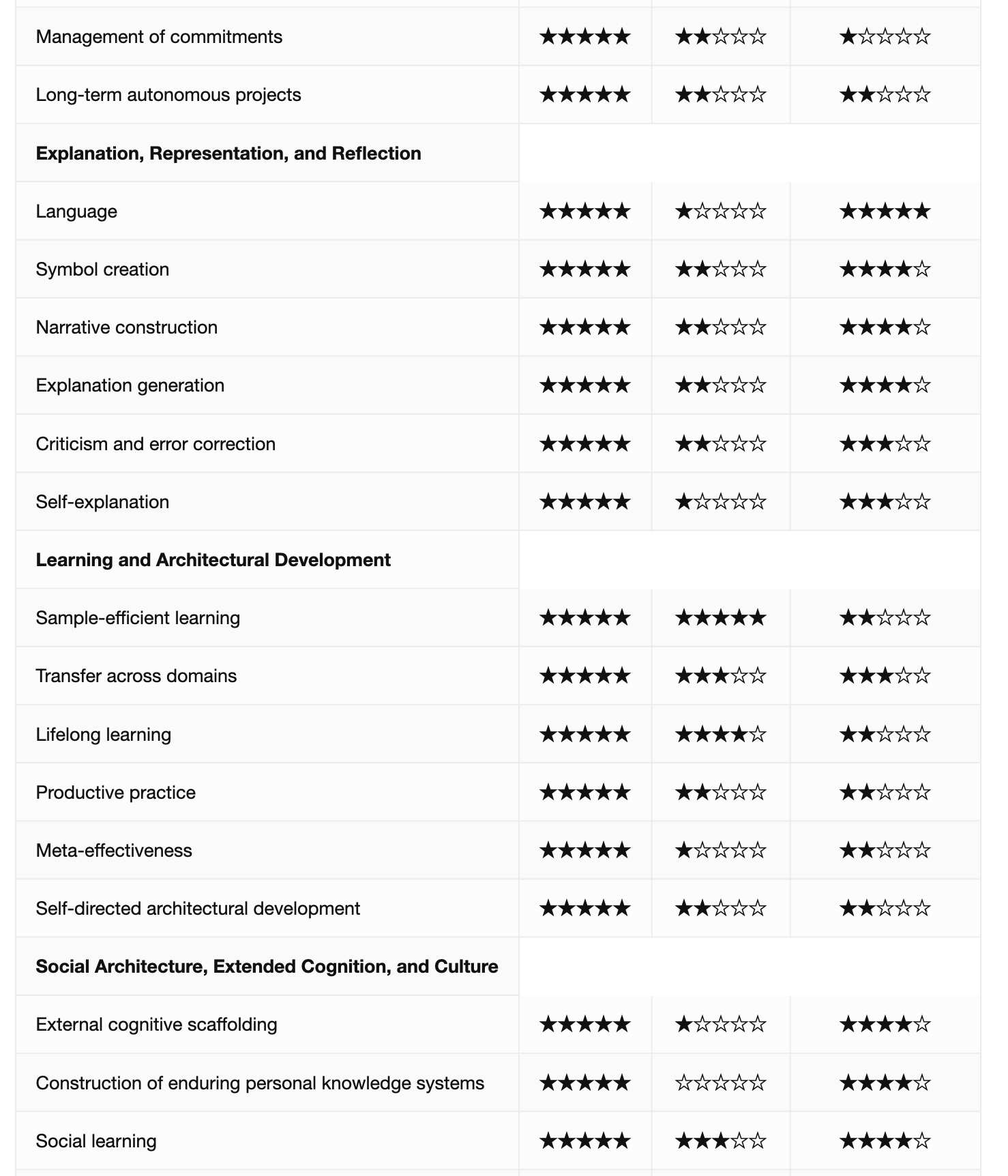
Table 2 below provides a much more detailed way of comparing the intelligence of humans, great apes, and contemporary AI. Rather than scalar or multidimensional comparisons these comparisons in terms of mechanism of information processing.
Table 2. Comparing agent by processing capacity

9. Intelligence reconsidered
The central claim of this article is that intelligence is best understood as a property of information-processing architectures.
Binary classifications, scalar measures, and multidimensional profiles remain useful. They answer different questions and summarize important aspects of intelligent performance. But they do not by themselves explain how intelligent performance is produced.
An architectural conception directs attention toward mechanisms, representations, communication pathways, memory systems, motivational organization, learning processes, and developmental capacities.
It also helps us understand why two systems can perform similarly while relying on different architectures—or perform differently despite possessing many of the same mechanisms. Behaviour depends not only on architectural capacity but on knowledge, experience, current motivation, opportunity, and which mechanisms happen to be engaged.
Recasting intelligence in architectural terms does not diminish the importance of psychometrics, comparative cognition, neuroscience, education, or AI benchmarking. These disciplines provide evidence from which architectural properties can be inferred. Their findings become components of a deeper explanatory enterprise.
The architectural view also changes how we think about developing intelligence. Becoming more intelligent is not only a matter of accumulating information or improving performance on selected tasks. It can involve improving attention, memory retrieval, planning, motivation, criticism, error correction, management, meta-management, and the design of one’s cognitive environment.
Such development is individual, social, and technological. People improve through interaction with teachers, collaborators, critics, institutions, books, diagrams, software, and AI systems. These resources can become functionally integrated with internal processes of memory, motivation, and control.
Intelligence is therefore not simply something an isolated organism possesses. It is something that can be developed, scaffolded, socially distributed, and technologically extended.
The question with which we began—Is AI intelligent?—invites a binary answer to a question that requires a much richer analysis.
A better set of questions is:
What kind of information-processing architecture does this system possess? What forms of intelligent activity does that architecture support? How are its mechanisms organized and regulated? What can it learn, and can it participate in directing its own development? How does this information processing architecture compare with specific others?
Performance gives us evidence with which to investigate these questions. But performance is not the final object of explanation. Behaviour provides evidence. Architecture provides the explanation.
If intelligence is not binary, neither is it merely scalar or multidimensional. More fundamentally, intelligence is a property of information-processing architectures.
10. From intelligence to consciousness
The same principles apply when we ask whether AI, other animals, or other forms of autonomous agency are conscious. The question “Is this system conscious?” treats consciousness as a binary property and risks suppressing important differences among forms of awareness and control. Asking only how conscious a system is replaces the binary judgment with a scale but may still conceal qualitative differences. A multidimensional account can distinguish sensory awareness, bodily awareness, self-awareness, social awareness, reflective awareness, and intermediate- or long-term consciousness, but it remains primarily descriptive.
An architectural conception asks how these forms of consciousness are produced: which perceptual, attentional, mnemonic, motivational, managerial, meta-managerial, alarm, narrative, and self-representational mechanisms are present; how they interact; and over what timescales they can govern activity. Humans, other animals, and artificial systems may exhibit both continuities and discontinuities in these respects. We should therefore investigate not only whether or to what extent a system is conscious, but what kinds of consciousness its architecture makes possible and how those forms of consciousness contribute to autonomous agency.
If you want to find out more and have my definition of intelligence see a long exerp If Intelligence Isn't Binary, What Is It?